
Abstract
One of the main requirements for evaluating the performance of polymeric materials and preventing defects in polymeric products is to evaluate their resistance to environmental stresses or crack growth. Preferably, the polymeric material should be exposed to most chemicals and evaluated for ESC testing before use. Given the wide range of different chemicals, this evaluation is difficult, however, it has been found that most of the resulting cracks are caused by contact with liquids such as cleaning agents or lubricants. The resistance of polymeric materials to ESC is known as ESCR (Environmental Stress Cracking Resistance). ESCR can be measured by critical strain, critical stress or time-stress to failure. ESC evaluation in thermoplastics is carried out according to national and international standards. Since standard test methods for measuring ESCR on plastics take a long time, if the failure time exceeds a certain limit, the material quality is considered acceptable.
Keywords: Crack growth, ESC, ESCR.
Introduction
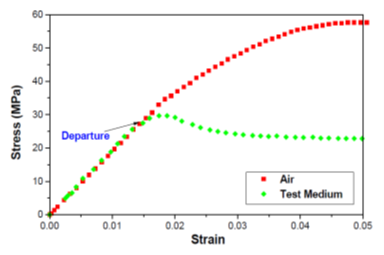
Crack growth under environmental stress is one of the most important causes of defects and failures in thermoplastic polymers, especially amorphous polymers, currently known. According to ASTM D883, ESC is defined as external and internal cracking of a plastic caused by a reduction in tensile stresses relative to its short-term mechanical strength. This type of crack usually involves brittle cracks with little or no material elongation from the cracked surface. This behavior is especially common in amorphous and glassy thermoplastics. In the case of amorphous polymers, due to their loose structure, fluid easily penetrates their structure. Amorphous polymers are more susceptible to crack growth at temperatures above their glass transition temperature (Tg) due to the increase in volume. As Tg is approached, more fluid penetrates into the polymer chain. Research shows that exposing polymers to liquid chemicals enhances the hairline crack propagation process, such that hairline cracks begin to grow at much lower stresses than those required to cause hairline cracks in air (Figure 1).
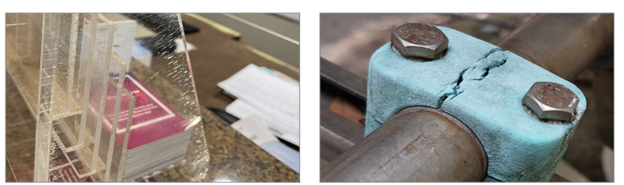

Tensile stress or corrosive liquid alone is not sufficient to cause failure; in ESC, the simultaneous presence of both stress and chemical corrosive liquid leads to crack initiation and growth. These test methods can be divided into two groups based on the deformation and applied load.
Test based on deformation:
• Bent Strip Test
• Bending bar test for flexible materials
• Ball and pin impression
• Constant tensile deformation
• Slow strain rate test
Test based on constant load:
• Constant tensile stress
• C-ring tests
The following section briefly introduces ESC test methods. It should be noted that there is no standard for testing ESC strength under cyclic or biaxial stresses. However, research shows that ESC strength can be significantly weaker when biaxial stresses are used instead of uniaxial stresses.
1. Bent Strip Test
In the bent bar test (ISO 4599), a rectangular specimen is bent into a semicircle (C shape) and a strain is applied to it. The radius of each bar can be different to induce different strains in the specimen. This strain can be calculated using the following equation:
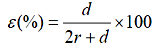
where d is the thickness of the sample and r is the radius of the first sample. Once the sample is flattened, it is quickly exposed to the chemical environment. After an agreed time, the sample is removed from the apparatus and visually assessed for wear or mechanically assessed to assess its residual strength.
This test is mostly used to evaluate amorphous polymers. It is not suitable for semi-crystalline polymers because the stress applied to the sample decreases during the test.
2. Bent strip test for flexible materials
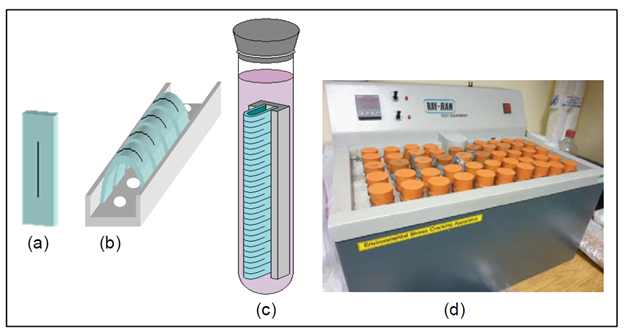
This test was developed by Bell Laboratories in the United States and has since been standardized as ASTM D1693. The technique is suitable for flexible polymers such as polyethylene but is best used for quality control purposes. A picture of the type of apparatus used in this method is shown in Figure 2.
The specimens used in this test are rectangular slotted strips (38 × 13 × 3 mm) that are clamped in a jig and the specimen is bent 180° on itself to create tension. After loading into the jig, the specimens are immediately exposed to the chemical environment under the desired test conditions. The specimens are then inspected visually or by automated inspection techniques at specified intervals, and the time required for 50% of the specimens to fail is taken as the evaluation criterion.

3. Ball and pin impression
The ball and pin molding test is primarily used for complex end products. This method involves creating a series of holes of a specific diameter in the polymer. A series of large balls or pins are inserted into the holes to create a range of different stresses. One hour after the pins are inserted, the samples are immersed in the environment for 20 hours. The samples are then dried and visually inspected for hairline cracks. To determine the ESC resistance of the polymer, the smallest ball that causes visible warping is considered in the calculations.
4. Constant tensile deformation
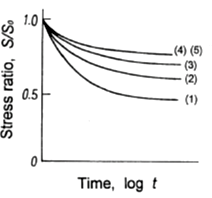
The constant tensile deformation test is a relatively new test that is currently being developed as an ISO standard as ISO DIS 22088 Part 5. The test method involves applying a constant deformation to the specimen and monitoring the stress reduction that occurs while the specimen is immersed in the solution. The test is repeated at small, incremental deformation intervals until the stress reduction curves of successive tests overlap (Figure 3). The applied stress required to produce this level of deformation is defined as the critical stress. The ESC strength of the material is determined by comparing the critical stress obtained in the environment with the stress obtained in air.

5. Slow strain rate test
The slow strain rate method has recently been used to characterize the performance of plastics, although it has been well studied for metals and is currently being developed as ISO DIS 22088 Part 6. The test method involves exposing a specimen to a chemical environment and increasing the strain on the specimen at a constant displacement. Tests are performed under uniaxial tension at low strain rates to enhance the effect of the stress-reduction curves of Figure 3 obtained by using smaller deformation levels (1>5), this is continued until successive curves overlap (3 and 4). In Figure 3, S0 is the initial stress and S is the stress at time t. The load and displacement are continuously monitored to produce the stress-strain curves. The formation of hairline cracks in the specimen causes the strain to be localized in the cracks, so that the stress required to deform the specimen is reduced compared to the inert environment. In this way, the onset of cracking can be detected by the deviation of the stress-strain curve in the chemical environment relative to the air curve in Figure 4. The main advantages of the slow strain rate method are that it is relatively fast, requires few samples, and can be automated.

6. Constant tensile stress test
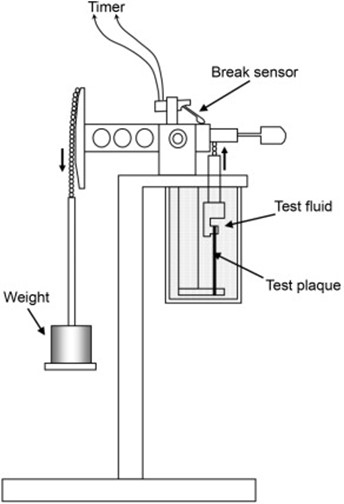
The distinctive feature of this test is that a constant load is applied to the specimens, thus eliminating the stress reduction problem encountered in constant strain testing methods. A picture of the type of apparatus used in this test method is shown in Figure 5. This technique involves subjecting the specimen under examination to a constant tensile stress at a stress less than the tensile yield stress of the polymer. This value is usually obtained by using a weight suspended from one end of the specimen. The specimen is then immersed in the stress cracking agent and examined at specified intervals to determine the onset of indentation. The time required for cracks to develop after exposure to the environment, or the threshold stress below which no cracks appear within a specified time period (usually 100 hours), can be used as a measure of ESC resistance.

7. C-ring tests
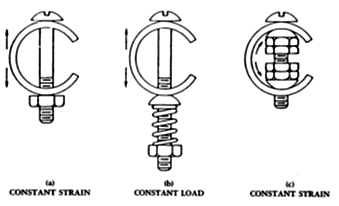
C-ring specimens are often used for pipe testing and are standardized for testing polyethylene pipe in ASTM F-1248. A typical apparatus for testing C-ring specimens is shown in Figure 6. Circumferential stress is the factor under investigation, and this stress varies around the circumference of the C-ring from zero at each hole to a maximum stress on the opposite side of that hole at the outer surface of the mid-arc. C-rings can also be stressed in the reverse direction by expanding the ring and creating tensile stress on the inner surface. By placing a calibrated spring on the loading screw, a nearly constant load can be applied to the C-ring specimen. This results in self-loading, which is particularly useful for monitoring deterioration in inaccessible locations.

8. Self-loading tests
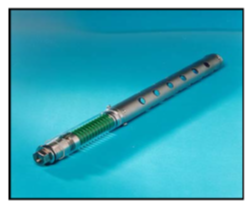
The self-loading tensile test is not common in plastics testing and has not been standardized. However, it is very useful for examining plastics because it can be placed in the same environment as the material being tested (for example, in a polymer pipeline). There are several ways in which specimens can be self-loaded, the most common of which is to create a constant tension in the specimen by using a compressed spring to apply the desired load. An example of this type of jig is shown in Figure 7. The specimen is held inside a tube and tension is applied by turning a screw at the end of the tube to compress the spring. The advantage of this method over C-ring tests is that it creates a simple and uniform stress pattern within the specimen.

Compiled by: Marzieh Shams Harandi
Scientific Editor: Mehrnaz Bahadori