
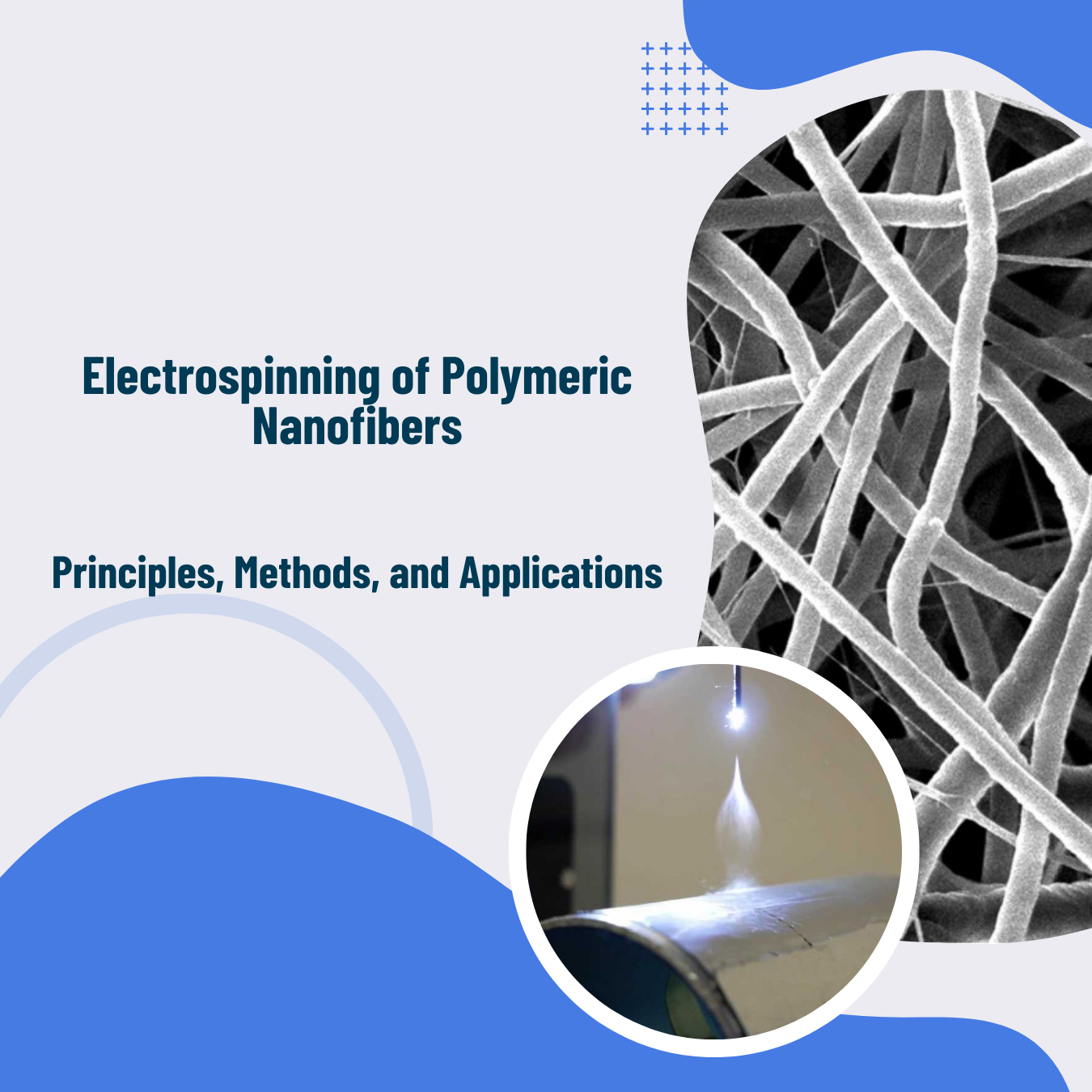
Electrospinning is one of the most widely used and efficient methods for producing ultrafine polymer nanofibers with diameters ranging from a few nanometers to a few micrometers. This technology, which is closely related to nanotechnology in polymers, allows for precise control of the structure, morphology, and functional properties of the fibers.
In this article, a comprehensive review of the electrospinning process of polymer nanofibers is presented, including a review of the fundamental principles, key parameters affecting fiber morphology, different electrospinning methods, and its extensive applications in fields such as biomedical engineering, filtration, energy storage, and advanced textiles. The challenges and future prospects of this technology are also discussed.
A review of the basic principles of electrospinning polymer nanofibers
Electrospinning is a simple, efficient, and cost-effective method for producing continuous nanofibers from polymer solutions or melts under the influence of an electric field. Since its introduction in the early 20th century, electrospinning has attracted widespread attention in the fields of polymer chemistry and engineering due to its ability to produce fibers with very high surface-to-volume ratios, tunable porosity, and desirable mechanical properties.
These properties have made electrospun nanofibers a suitable option for a variety of applications, including tissue engineering scaffolds, controlled drug release systems, advanced filtration membranes, and electronic devices.
Fundamentals of the electrospinning process
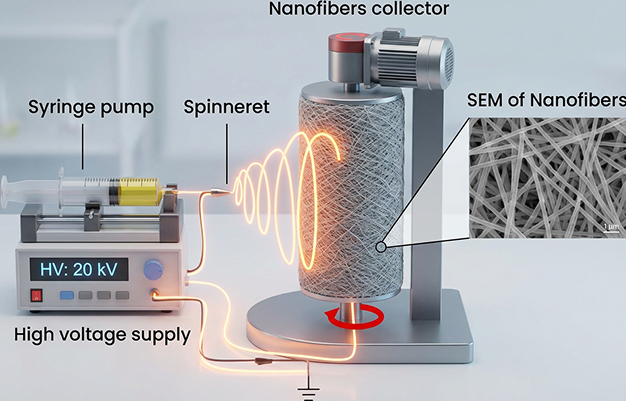
The electrospinning process is based on the application of a strong electric field and generally consists of three main components, each of which plays a decisive role in the formation and morphology of nanofibers:
- High voltage power supply
By creating a strong electric field, this section provides the force necessary to overcome the surface tension of the polymer solution or melt, enabling the formation of a polymer jet and its stretching into thin fibers.
- Spinneret (needle or capillary tube)
The spinneret is responsible for transporting and uniformly feeding the polymer solution or melt to the electric field area, and its geometric characteristics can affect the stability of the jet and the diameter of the fibers.
- Collector
The collector, as a collection surface, receives the electrospun nanofibers, and its type and arrangement play an important role in the orientation, arrangement, and final structure of the nanofibers.
Mechanism of the electrospinning process
The electrospinning mechanism can be divided into several sequential and interconnected steps that ultimately lead to the formation of polymer nanofibers:
- Impregnation of polymer solution or melt
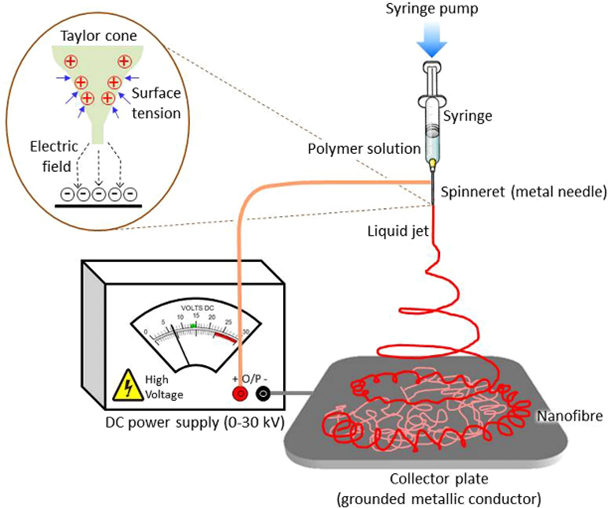
In this step, a high voltage (usually in the range of 5 to 30 kV) is applied to the polymer solution or melt. This voltage causes the separation and accumulation of electrical charges in the polymer fluid and provides the necessary basis for the application of electrostatic forces.
- Taylor cone formation
As the electric field intensity increases, electrostatic forces overcome the surface tension of the polymer solution and the fluid surface at the spinneret tip takes the form of a distinct conical structure called a Taylor cone.
- Starting and stretching the polymer jet
After the electrostatic forces reach a critical limit, a charged polymer jet emerges from the tip of the Taylor cone. Under the influence of electrostatic repulsion between like charges and simultaneous solvent evaporation, this jet undergoes severe stretching and whiplash instability, and its diameter decreases significantly.
- Formation and assembly of nanofibers
Finally, the drawn polymer jet is transformed into solid nanofibers and collected on a predetermined collector or substrate. The characteristics of the collector play an important role in the arrangement, orientation, and final structure of the nanofibers.
Key parameters affecting the electrospinning process
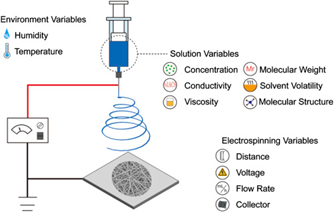
The morphology, uniformity, and functional properties of electrospun nanofibers depend on a set of interrelated parameters. These parameters are generally classified into three main categories: solution parameters, process parameters, and environmental parameters.
Polymer solution parameters
The properties of the polymer solution play a decisive role in the formation of a stable jet and the final morphology of the nanofibers:
Polymer concentration
Polymer concentration is one of the most important factors affecting fiber diameter; increasing the concentration usually leads to an increase in nanofiber diameter.
Solvent volatility
The type and volatility of the solvent has a direct impact on the evaporation rate, jet drying, and formation of the fiber surface structure.
Solution viscosity
Appropriate viscosity is a prerequisite for the formation of continuous fibers; too low viscosity causes the formation of droplets and beads, and too high viscosity prevents the emergence of a stable jet. In this context, the use of polymer processing aids can play an important role in regulating the rheological behavior of the solution.
Electrical conductivity of the solution
افزایش رسانایی الکتریکی بهدلیل افزایش چگالی بار در جت پلیمری، معمولاً منجر به کشش بیشتر و تولید نانوالیاف نازکتر میشود.
Process parameters
The operating parameters of the electrospinning machine also play an important role in controlling the process and fiber quality:
Applied voltage
The voltage value controls the onset of jet formation and the amount of fiber tension, and increasing it too much can cause process instability.
Solution flow rate
Flow rate affects fiber diameter and the likelihood of bead formation; higher rates typically result in thicker fibers and incomplete solvent evaporation.
Distance between spinneret tip and collector
This distance has a direct impact on the solvent evaporation time and the way nanofibers are deposited on the collector.
Environmental parameters
The environmental conditions surrounding the electrospinning process should also not be ignored:
Ambient temperature and humidity
These parameters affect the rate of solvent evaporation, polymer crystallization, and the final morphology of nanofibers and can cause significant changes in the fiber structure.
Types of electrospinning methods
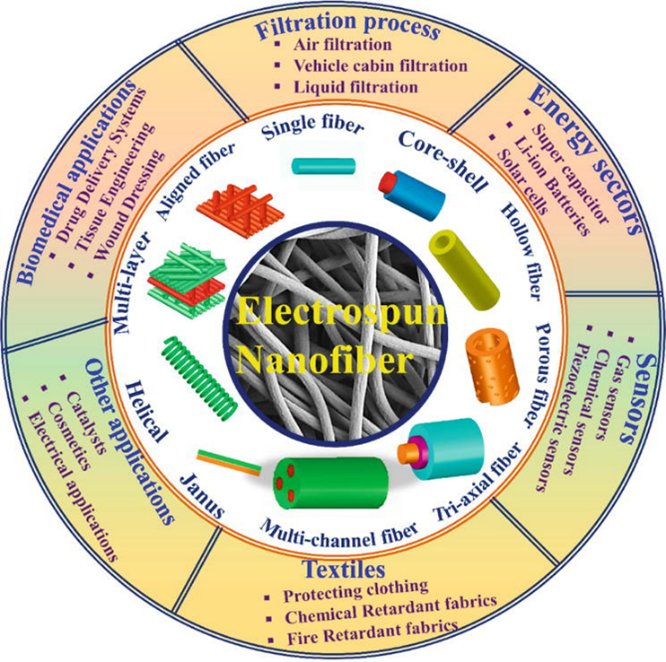
Depending on the type of polymer material, application purpose, and process requirements, various electrospinning methods have been developed, each with its own characteristics and advantages.
Solution electrospinning
The most common and widely used method is electrospinning, which uses a polymer solution to produce nanofibers. In this method, the appropriate selection of polymer and solvent plays a key role in controlling the morphology, diameter, and uniformity of the fibers, and is often used for research and industrial applications.
Melt electrospinning
In this method, a polymer melt is used instead of a polymer solution. Melt electrospinning eliminates the need for organic solvents and is considered a more environmentally friendly option, although it requires higher temperatures and more specialized equipment.
Core–Shell Electrospinning
This method enables the production of core-shell nanofibers and is widely used for controlled drug release systems and the production of multipurpose fibers. The control of the core-shell structure is directly related to the selection of materials, process parameters, and polymer additives.
Emulsion electrospinning
In emulsion electrospinning, stable emulsions are used to encapsulate active compounds. This method is particularly useful for encapsulating hydrophobic or hydrophilic drugs within nanofibers and is considered a suitable alternative to axial electrospinning in some biomedical applications.
Needle-free electrospinning
Needle-free electrospinning enables mass production of nanofibers by creating multiple jets from the free surface of a liquid and is recognized as one of the important methods in industrial scalability.
Applications of electrospun nanofibers
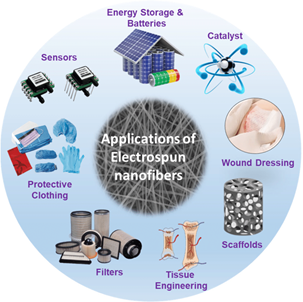
Nanofibers produced by electrospinning have found widespread applications in various scientific and industrial fields due to their high specific surface area, controllable porosity, and the possibility of chemical modification.
Medical and biomedical applications
Electrospun nanofibers are widely used in the medical field:
Tissue engineering
The use of nanofibers as scaffolds for cell growth and proliferation in tissues such as skin, bone, and nerve regeneration is very common, especially in biopolymer-based systems.
Controlled drug release
The porous structure and encapsulation capability of nanofibers allow for gradual and targeted release of drugs.
Wound dressing
Nanofibers with antibacterial properties and gas permeability help improve the wound healing process and reduce infection.
Filtration applications
Electrospun nanofibers are an ideal choice for filtration applications due to their very small diameter and high specific surface area:
Air and water filtration
Used in HEPA filters and polymer filtration membranes to remove particulate matter, pollutants, and microorganisms.
Energy storage and conversion
In the energy sector, nanofibers play an important role in improving the performance of electrochemical devices:
Batteries and supercapacitors
Using nanofibers as electrodes or electrode supports helps increase conductivity and improve ion transport.
Fuel cells
The use of nanofibers in proton exchange membranes increases the efficiency and stability of the system.
Advanced textiles and wearable electronics
In modern textile industries, nanofibers have enabled the development of smart products:
Smart fabrics
Textiles equipped with sensors and conductive fibers for monitoring environmental and biological conditions.
Protective clothing
Production of waterproof, antibacterial and chemical and biological resistant membranes.
Environmental applications
Electrospun nanofibers also have important applications in the environmental field:
Separating oil from water
Using hydrophobic/hydrophilic nanofibers to clean up oil spills and treat wastewater.
Environmental catalysis
Using nanofibers as catalyst carriers for the destruction of organic and inorganic pollutants.
Challenges and future prospects of electrospinning
Despite the significant advantages of the electrospinning process, this technology still faces challenges that limit its widespread development and commercialization. One of the most important challenges is the low production rate in conventional needle-based systems, which limits industrial scalability. In addition, the use of some volatile and toxic organic solvents in solution electrospinning raises environmental and safety concerns. On the other hand, achieving complete uniformity in the diameter and morphology of nanofibers, especially under varying operating conditions, remains one of the major technical challenges of this process.
On the contrary, the future prospects of electrospinning are promising for the development of new solutions to overcome these limitations. One of the most important directions is the development of green electrospinning through the use of bio-based and environmentally friendly polymers and the replacement of harmful solvents with environmentally friendly systems. Also, the design and application of advanced collectors enable the production of electrospun 3D structures and expand the application of this technology in tissue engineering and complex scaffolds. In addition, new approaches based on hybrid electrospinning, in which electrospinning is combined with other nanofabrication methods such as 3D printing, have opened new horizons for the production of multifunctional materials and advanced systems.
The role of polymer materials and additives in improving the electrospinning process
Precise control of the morphology, uniformity, and functional properties of electrospun nanofibers depends on the chemical composition of the polymer system and the rheological behavior of the solution or melt. In this regard, polymer processing aids play an important role in achieving uniform and stable fibers by adjusting viscosity, improving jet stability, and reducing bead formation.
In addition, in some polymer systems, the use of polymerization initiators such as DTBP can improve the mechanical and thermal properties of nanofibers by modifying the molecular structure and controlling chemical reactions. In engineered and multilayer applications, tie layer adhesives are considered as an effective solution to increase adhesion and integration between different polymer phases, allowing the development of more advanced structures.
Conclusion
Electrospinning, as a powerful, flexible, and efficient method for producing polymer nanofibers, has found a special place in various fields, including medicine, filtration, energy storage, and advanced textiles. The ability to control the structure, morphology, and functional properties of nanofibers has made this technology one of the key tools in the development of advanced materials.
At the same time, current research in the field of electrospinning is focused on improving industrial scalability, reducing environmental impacts, and increasing process efficiency. The development of approaches such as the use of bio-based and sustainable polymers, the design of novel electrospinning systems, and the integration of this technology with other nanofabrication methods have provided new avenues for expanding its applications. As these developments continue, electrospinning is expected to play an increasing role in nanotechnology, materials science, and advanced industries in the future.
Resources:
1. Doshi, J., & Reneker, D. H. (1995). Electrospinning process and applications of electrospun fibers. Journal of Electrostatics, 35(2-3), 151-160. [Foundational work on electrospinning]
2. Huang, Z. M., Zhang, Y. Z., Kotaki, M., & Ramakrishna, S. (2003). A review on polymer nanofibers by electrospinning and their applications in nanocomposites. Composites Science and Technology, 63(15), 2223-2253. [Comprehensive review on electrospinning applications]
3. Li, D., & Xia, Y. (2004). Electrospinning of nanofibers: Reinventing the wheel? Advanced Materials, 16(14), 1151-1170. [Key advancements in electrospinning techniques]
4. Greiner, A., & Wendorff, J. H. (2007). Electrospinning: A fascinating method for the preparation of ultrathin fibers. Angewandte Chemie International Edition, 46(30), 5670-5703. [Detailed discussion on electrospinning mechanisms]
5. Bhardwaj, N., & Kundu, S. C. (2010). Electrospinning: A fascinating fiber fabrication technique. Biotechnology Advances, 28(3), 325-347. [Biomedical applications of electrospun nanofibers]
Content compiler: Maedeh Pirgharib Nawaz
Scientific Editor: Dr. Mehrnaz Bahadori