
Abstract
Polypropylene (PP) is one of the most widely used and basic polymers in the world with excellent chemical, physical and mechanical properties. This material is recyclable and does not harm the environment with proper management by consumers. It is relatively resistant to heat and does not release toxic substances into the environment. In addition, the polymer produced from propylene monomer is usually resistant to chemical solvents, bases and acids, which indicate the wide application of this polymer in everyday life. This thermoplastic polymer is used in various industries including film and sheet, blow molding, injection molding, food packaging, textiles, laboratory and medical equipment, pipes, industrial and construction applications and especially in the manufacture of automotive components. This polymer is used in approximately thirty percent of automotive parts.
Keywords: polymer, polypropylene, thermoplastic, properties, application
Introduction
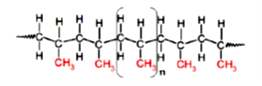
Polypropylene is a petrochemical product formed by the polymerization of propylene monomers by applying heat and adding an initiator or catalyst to the reaction medium. There are four different methods for producing polypropylene, including solution, suspension, bulk, and gas phase polymerization. The properties of PP are determined by the process conditions, copolymer composition, and molecular weight distribution. As shown in Figure (1), PP is a vinyl polymer, in which each carbon atom is bonded to a methyl group.
It should be noted that polymer materials are divided into four main groups: thermoplastics, thermosets, elastomers, and polymer blends. Elastomers and thermosets are soft and hard elastic, respectively, and their resins cannot be remelted or recycled. While thermoplastics are amorphous or quasi-crystalline and recyclable. Polypropylene is included in the thermoplastic group, and its modification and reinforcement with different additives creates polymers with high mechanical properties.
Polypropylene is a thermoplastic polymer that has good flexibility in molding, in addition to excellent resistance in the presence of concentrated and diluted acids, alcohols, aldehydes, esters, ethers and oxidizing agents. This polymer, with a crystalline structure, has a high melting point compared to other commercial thermoplastic polymers. Hence, its properties will be interpreted.
Polypropylene properties
To understand the different types of polypropylene, it is necessary to examine the classification of thermoplastic polymers from a different perspective.
Thermoplastic polymers are classified into two groups:
Common thermoplastic polymers (Commodity): This group covers major polymers such as polyethylene, polypropylene, polystyrene, and polyvinyl chloride.
Engineering thermoplastic polymers: The second group of thermoplastic polymers are those that are used in electrical and mechanical engineering applications. These include polysulfone, nylon, polycarbonate, acetal, and ABS terpolymers.
There are two different types of polypropylene. The first type is polypropylene that contains only the propylene monomer in a semi-crystalline solid form, which is called homopolymer (HPP). When a monomer other than propylene is used in the polypropylene structure, we have a polypropylene copolymer. Polypropylene itself is divided into two categories: block copolymer and random copolymer. In block copolymer, the ethylene segments are located between the propylene segments along the polymer chain, while in random copolymer, the ethylene monomers are located irregularly and separately along the polymer chain. HPP is the most widely used type of polypropylene in the industry. HPP is a two-phase system that includes crystalline and non-crystalline parts. The non-crystalline regions are isotactic PP (iPP) and atactic PP (atactic). Isotactic PP is crystallizable in amorphous regions and crystallizes slowly over time. In other words, HPP consists of only one isotactic propylene unit, giving the polymer a crystalline structure. Therefore, HPP has high strength and melting point at room temperature but exhibits low impact strength. Random copolymers are ethylene/propylene copolymers produced in a reactor by copolymerizing propylene and small amounts of ethylene (usually 7% or less). Ethylene disrupts the regular structure of polypropylene and leads to a decrease in the uniformity of crystallinity in the polymer, meaning that as the ethylene content increases, the crystallinity gradually decreases and the melting point decreases. Copolymers usually have slightly better impact properties, lower melting points, and higher flexibility. For better understanding, the properties of polypropylene are discussed in Table 1.
Table 1. Advantages and disadvantages of polypropylene
| Advantages of polypropylene | Disadvantages of polypropylene | |
| Copolymer | Homopolymer | Destruction by ultraviolet radiation |
| High processability | Good processability | Flammable |
| High impact resistance | Good impact resistance | Degradation by aromatic and chlorinated solvents |
| High strength | Adequate strength | Poor impact strength at low temperatures |
| Food contact – unsuitable | Food contact – suitable | Problem creating link |
Isotactic semi-crystalline structures have three crystal structures, including monoclinic (𝛼), trigonal (𝛼), and orthorhombic (𝛼) structures. Reducing crystallinity increases product transparency. Isotactic polymers are extruded several times, recycled, and cooled after the extrusion process to observe the effect of recycling on turbidity. The results show that turbidity decreases with increasing recycling steps and cooling rate. However, increasing the amount of 𝛼 phase and increasing the average size of monoclinic structures increase turbidity. Isotactic polypropylene (β-iPP) is another commercial example with unique properties. For example, the toughness and impact strength of β-iPP are significantly higher than that of 𝛼-iPP. The development of the β phase is completed by crystallinity in a temperature gradient. However, β modification cannot replace the use of 𝛼 modification, because each type of crystallinity has its own unique characteristics. The results show that iPP types have excellent mechanical properties and good optical properties. It is worth noting that recycling of polymers reduces their mechanical and optical properties. Optical properties are very important for food packaging applications. Considering the mentioned properties of PP, along with the preservation of desirable properties after recycling, this is considered a unique feature of this polymer.
Commercial products of this polymer are available in various molecular weights, monomers, and additives. Improved physical properties allow polypropylene to be the primary material in most applications such as films, fibers, tapes, sheets, blow-molded products, and injection-molded products. Some of the thermal properties, including melting point, crystallization temperature, and degradation temperature, of commercial polypropylene are shown in Table 2 in comparison with other polymers.
Table 2. Phase transition temperatures for quasi-crystalline resins
| Resin | Tg | Tm | Td |
| HDPE | -95 | 130-146 | 360-390 |
| PA 6 | 40 | 220 | 327 |
| PEEK | 120 | 340 | ––– |
| PP | -18 | 160-208 | 336-366 |
| PTFE | -20 | 327 | 424-513 |
Therefore, this lightweight polymer with a density of 0.9, along with the other mentioned properties, will have many applications in industry.
Applications of polypropylene
1) Fibers and fabrics
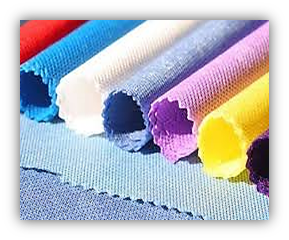
Fibers are produced using different PP extrusion processes. PP, with properties such as lower density, strength, chemical resistance and stain resistance, offers a variety of fiber applications such as artificial turf, sewing thread, various fabrics and napkins (Figure 2).
2) Movie
PP films are produced through an extrusion process. The film thickness is less than 10 mm. These films have been used in food products, adhesive tapes and clothing.
3) Car
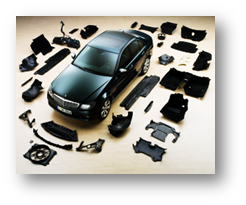
Many of the polymers used in new cars are PP, as car companies want to reduce the overall weight of their cars to save customers on some costs, such as gasoline. PP is used in the construction of doors, bodywork, pillars, etc. of cars, the most important advantage of which is its lightness. Weight reduction has been an important factor, so PP has become a major material for exterior car parts (Figure 3).
4) Sheet production using the thermoforming process
The thermoforming process involves heating a thermoplastic sheet to its softening point and then forming the softened sheet into the desired shape. The extrusion process produces a sheet that is more than 10 mm thick. The sheet width is typically between 2-7 feet. The sheets are used in the production of thermoformed containers for packaging applications.
5) Injection molded products
In this process, polymer granules are melted after heat is applied, and the molten material is then injected into a closed mold. The mold usually consists of two halves that are pressed together to overcome the force of the melt. The injected material then cools and solidifies. Injection molding is used to produce some household appliances and hand tools, as well as in various medical applications such as disposable syringes.
6) Blow molding products
In the blow molding process, a hollow object is produced by blowing hot air into a thermoplastic polymer. In the blow molding process, a hollow tube of thermoplastic material called a parison is produced and placed inside a closed mold. After blowing hot air, it takes the shape of the mold and retains its shape after exiting the mold. Bottles and jars are the main products of the blow molding process.
7) Pipes and fittings
Polypropylene pipes are widely used in various industries. These pipes are very suitable as thermal and electrical insulation. Since opening and closing pipes is a necessity for operational applications, one of the advantages of polypropylene pipes is that they can be opened and closed many times without being subject to erosion.
Polypropylene pipes have a smooth and polished surface inside and outside the pipe, which makes it easy for fluids to move inside the pipe. These pipes have a long life and are anti-algae. Also, due to their light weight, these pipes are easy to transport. Polypropylene pipes have a high melting point and flexibility. The price of these pipes is low and they are used as an alternative to metal and cast iron pipes. Other advantages of polypropylene pipes include things like speed in installing pipes, resistance to decay and corrosion, and resistance to freezing. Some features of these pipes, such as high chemical resistance, resistance to aqueous solutions, alkalis, acids, salts, and organic solvents, have made polypropylene pipes useful in various cases. These pipes are used in drinking water piping systems. Polypropylene pipes are used in various applications, including the food industry, building plumbing, building heating installations, solar heating systems, compressed air lines, acidic and alkaline environments, toy manufacturing, shipbuilding, automotive, laboratory and medical equipment, water transportation, sewage systems, textile industry, chemical discharge systems, and drinking water piping (Figure 4).

In order to improve the properties of PP pipes, in 2004, a new generation of crystallinity-modified polypropylene random copolymer (PP-RCT) with improved hydrostatic pressure resistance was designed and produced by Borealis.
Crystallinity modification provides them with unique advantages, including:
- Increased impact resistance
- Increased thermal resistance
- Increased long-term creep strength
- Increasing extrusion speed
- Significant improvement in weldability
The mechanical properties of PP-RCT produced by Borealis are as shown in Table 3.
Table 3. Mechanical properties of PP-RCT granules
| Type | Melt flow index (10g/min) (230°C/ 2.16k) | Tensile stress at yield point (MPa) | Tensile modulus (MPa) | Charpy notch impact At 23°C (kJ/m2) | Charpy notch impact At -20°C (kJ/m2) |
| RA7050 | 0.3 | 25 | 905 | 40 | 2 |
In order to achieve these desirable properties in the pipe, for the first time in our country, Iran, Behin Pardazan Koosha Company, a subsidiary of Giti Pasand Group, has succeeded in producing PP-RCT masterbatch, which is used in Azin Luleh Company in the production of single-layer and three-layer PP-RCT pipes. The PP-RCT pipes produced, despite their smaller thickness, have shown better properties and have been certified by the Road, Housing and Urban Development Research Center in the Ministry of Roads and Urban Development.
Conclusion
PP applications have shown that among other polymers, PP is a suitable choice for producing flexible, durable, inexpensive and lightweight polymers for various industrial, commercial, medical and personal uses. The presence of alkyl branches on the linear polypropylene chain results in polymers with high modulus, tensile strength and heat resistance. Also, despite the fact that recycling of polymers reduces their optical properties, semi-crystalline isotactic polypropylene shows excellent mechanical properties and suitable optical properties after recycling. Hence, the applications of PP are unlimited and include fibers, belts, films, etc. Therefore, modifying and changing the properties of polypropylene according to the application is vital and studies should be pursued in this direction to meet the future need.
Compiled by: Marzieh Shams Harandi
Scientific Editor: Samin Saleki
Resources
1. Hisham A. Maddah, Polypropylene as a promising plastic: A Review, American Journal of Polymer Science 2016, 6(1): 1-11.
2. Bikiaris, D., & Docoslis, A. Harutun G. Karian, Handbook of polypropylene and polypropylene composites, 2003.