
Abstract
This article reviews the application of antioxidants as additives in polymers to enhance their durability and performance. Polymers are widely used in various industries due to their versatile properties, but they are prone to degradation when exposed to environmental factors such as heat, light, and oxygen. Incorporating antioxidants into polymer formulations can effectively inhibit oxidation reactions and prevent the chain scission process, thereby extending the lifespan of the materials.
Keywords: Antioxidant, Additives, Polymer
Introduction
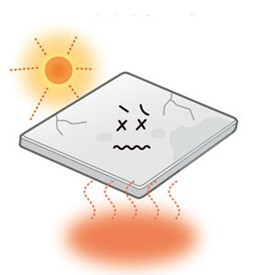
Polymers are widely used in various industries due to their diverse properties. However, exposure to various environmental factors such as heat, light, and oxygen can cause oxidative degradation of polymers, which leads to reduced performance and shorter lifespan of polymers (Figure 1). Oxidation is one of the factors that degrade many polymers and plastics, both during the production process and during the consumption cycle of the final product. As a result, today’s polymer product manufacturers must use antioxidant polymer additives to improve the quality of their products and also prevent oxidation and degradation of their final products. As a result, antioxidants are effective additives that are consumed in large quantities by various industries every year to inhibit or delay such degradation processes in polymers. This report is a review of antioxidants used in polymers, including their definition, properties, applications, and conclusions, which will provide a summary of their importance.

Definition of antioxidants in polymers
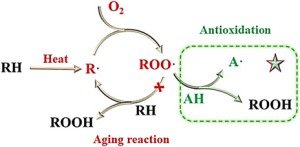
Antioxidants are substances that prevent or delay oxidation reactions by interrupting chain reactions initiated by free radicals. In polymers, antioxidants prevent oxidative degradation caused by the presence of free radicals, since the presence of free radicals and the occurrence of radical reactions can lead to the breakage of polymer chains, discoloration, loss of mechanical properties, and other harmful effects. The mechanism of action of this class of substances is shown in Figure 2.

Properties of antioxidants
Antioxidants used in polymers have key properties that contribute to their effectiveness. These properties include:
a) High thermal stability: Antioxidants must remain stable at high temperatures during processing operations to provide long-term protection of polymers.
b) Low volatility: Antioxidants must have a minimum vapor pressure so that they do not evaporate during processing and use.
c) Compatibility: They must be compatible with polymer matrices to ensure uniform distribution and efficient performance.
d) Synergistic effects: Some antioxidants perform better when used in combination with other additives, such as stabilizers or UV absorbers.
Types of antioxidants
Different types of antioxidants are used in various polymer applications, including:
A) Primary antioxidants:
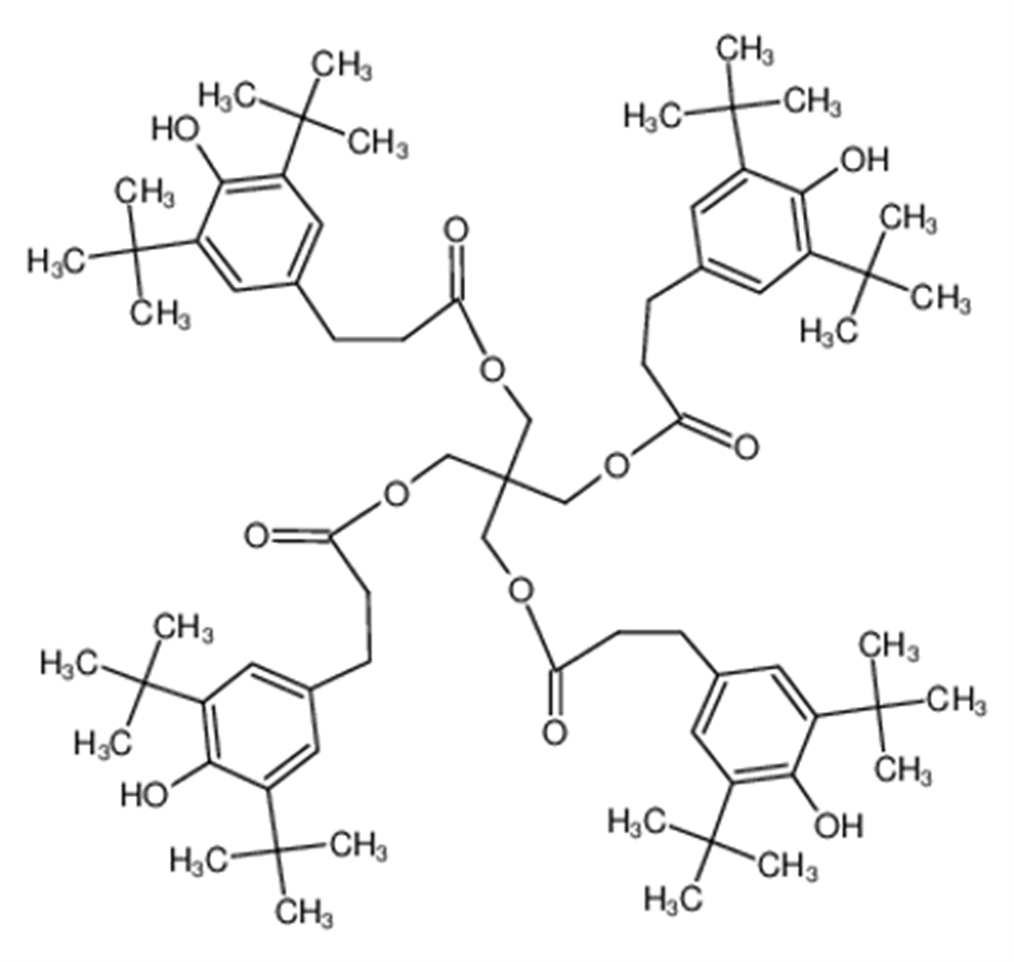
These antioxidants act as radical scavengers by transferring hydrogen atoms to free radicals, thereby terminating the oxidation chain reaction. Examples include some phenolic structures with highly hindered functional groups (e.g., Irganox 1010, the molecular structure of which is shown in Figure 3) and some hindered amine light stabilizers (HALS). It is important to note that the use of amine antioxidants affects the color of the final product and their use is limited in many applications.
B) Secondary antioxidants:
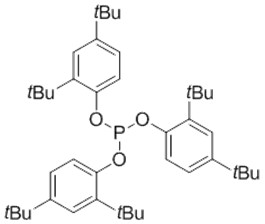
These antioxidants decompose peroxides formed during the oxidation process. Common secondary antioxidants containing phosphite or phosphonite groups or organic sulfur-containing compounds and dithiophosphonates are widely used in this field. Other common secondary antioxidants include thioesters such as dilauryl thiodipropionate (DLTDP), distearyl thiodipropionate (DSTDP) and some phosphites (e.g. Irgafos 168, the molecular structure of which is shown in Figure 4). It should be noted that phosphites exhibit synergistic properties with phenolic primary antioxidants. Phenolic antioxidants and phenolic phosphite compounds provide excellent protection against thermo-oxidative degradation and discoloration of polymers.

What factors does choosing the right antioxidant depend on?
The choice of antioxidants depends on various factors, including:
It depends on 1) the type of base polymer,
2) the extrusion temperature,
3) and the functional objectives for the application of the final product.
For example, for packaging products, it is better to use secondary antioxidants such as Antioxidant 168, because their oxidation occurs mainly during the production process. Whereas, for plastic products used in the open air, a combination of Antioxidant 1010 and Antioxidant 168 should be used, because oxidation can occur for such products both during the production process and during the consumption cycle.
Antioxidants are also added to agricultural films to improve thermal stability, prevent discoloration, and maintain transparency. The use of appropriate antioxidants in pipes is also important because these products are exposed to external environmental factors in the open air for long periods of time, which leads to their oxidation.
Application of antioxidants in the polymer industry and other industries
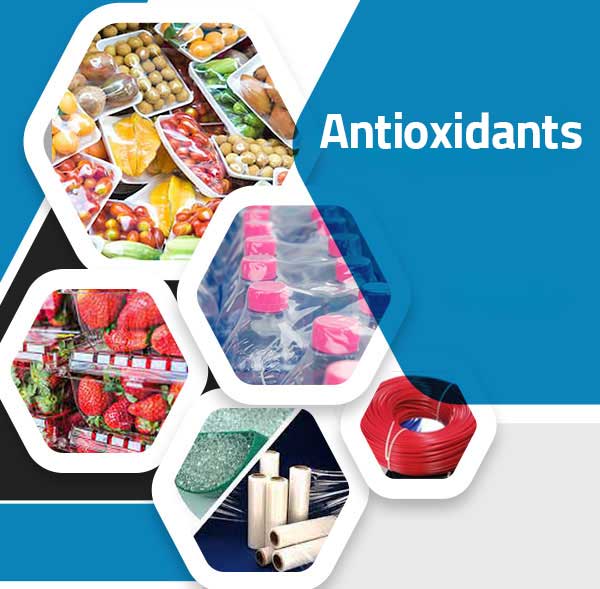
As previously mentioned, antioxidants have a wide range of applications in a variety of different polymer products, Figure 5 shows some of these applications:


The following is a brief summary of the uses of antioxidants in various polymers:
a) Polyolefins: Antioxidants are used in polyethylene (PE) and polypropylene (PP) to prevent degradation caused by heat, light, and processing.
b) Polystyrene (PS) and ABS: Antioxidants protect these polymers against discoloration, brittleness, and loss of mechanical properties during processing and long-term use.
c) Polyvinyl Chloride: (PVC) Antioxidants ensure the stability and integrity of PVC products when exposed to heat, UV radiation, and oxidative environments.
D) Rubber: Antioxidants are used in tires and also for sealing purposes, to prevent aging, cracking, and degradation of products.
Also in the textile industry, antioxidant masterbatches are used to protect fibers and fabrics from oxidative damage. This helps prevent discoloration, loss of strength, and deterioration caused by exposure to light, heat, and environmental factors. Antioxidant masterbatches are commonly used in the production of synthetic fibers, yarns, and textiles.
Additionally, antioxidant masterbatches are used in cosmetics and personal care products to prevent oxidative degradation and maintain product stability. This helps protect formulas containing oils, fats, and other vulnerable ingredients from oxidation, leading to longer shelf life and greater product performance.
Conclusion
Antioxidants play a vital role in maintaining the integrity and performance of polymers by reducing oxidative degradation. These materials extend product life and preserve polymer properties by interrupting oxidation chain reactions and scavenging free radicals. Their high thermal stability, low volatility, and compatibility with polymer matrices make them essential additives in a variety of applications. Choosing the right antioxidant type and concentration for each polymer system, taking into account the specific processing conditions and uses, is critical for optimal performance and longevity of the final product.
Compiled by: Zahra Dalatgari
Edited by: Dr. Mehrnaz Bahadori
Resources
1. Albertsson, A. C. (1998). Degradation and stabilization of polymers. In Polymer degradationand stability (Vol. 59, No. 1-3, pp. 199-207). Elsevier.
2. Bikiaris, D., & Docoslis, A. (Eds.). (2018). Polymer degradation and performance. CRC Press.
3. Sbirrazzuoli, N., & Long, Y. (2019). Antioxidants in polymers: Mechanisms and applications. Polymers, 11(7), 1135.
4. Kamal, M. R., & Ismail, A. H. (2012). Handbook of polymer nanocomposites. Processing, performance and application: volume C: polymer nanocomposites of cellulose nanoparticles. World Scientific.
5. Rao, P. V. (2005). Polymer blends and composites: Chemistry and technology. Springer Science & Business Media.
6. Pospíšil, J. (2016). Radical scavengers for polymers. Polymer Degradation and Stability, 132, 79-85.
7. Gijsman, P. (2000). Polymer stabilisation and degradation. Springer Science & Business Media.
8. Pospíšil, J., & Chodák, I. (2019). Antioxidants in polymers: An overview of principles and applications. In: Antioxidants in Foods and Its Applications. IntechOpen.
9. Jacob, M. (2013). Antioxidants: A review. Journal of Chemical and Pharmaceutical Research, 5(3), 271-278.
10. Sathyanarayana, D. N. (2019). Antioxidants in polymers. In Handbook of Antioxidants for Food Preservation (pp. 243-257). Elsevier