
Abstract
Copolymers are a class of polymers made up of two or more different types of monomers that offer a wide range of properties and applications. This article will review the classification and characteristics of this class of compounds, as well as their diverse applications in various industries including medicine, biotechnology, electronics, packaging, and energy storage.
Keywords: copolymer, monomer, application
Introduction
In the field of polymer science, copolymers have attracted much attention due to their exceptional properties and distinct structure compared to homopolymers. These materials are formed by the polymerization of multiple monomers in different configurations, resulting in a wide range of unique properties. Through strategic selection and combination of different monomers, researchers can design copolymers to meet specific goals, making them highly desirable materials in a variety of industries.
1. Definition of copolymers
Copolymers are a class of polymers produced through the polymerization process, in which two or more different types of monomers are chemically linked together. Monomers are small molecules that are capable of reacting with each other to form long chains called polymers. By using multiple types of monomers during polymerization, copolymers are created that have distinct properties compared to homopolymers (polymers consisting of a single type of monomer). Copolymers play an important role in the field of polymer science and have found wide applications due to their capacity to combine the properties of the individual monomers used in their structure, resulting in a wide range of material properties and characteristics.
The polymerization of copolymers can be carried out by a variety of methods, each of which affects the structure and properties of the resulting copolymer. The composition and structure of copolymers are determined by the combination of two or more different monomers during the polymerization process. The resulting copolymer has a unique arrangement of monomers that affects the properties and characteristics of the resulting polymer. The choice of monomers and how they are arranged in the copolymer chain affects the physical, chemical, and mechanical properties of the synthesized copolymer. Copolymers can be designed to combine the best properties of their constituent monomers, making them versatile materials with a wide range of applications. The composition and structure of copolymers can be tailored to meet specific industrial and technological needs, such as the production of specialty plastics, elastomers, coatings, and biomedical materials.
2. Classification of copolymers
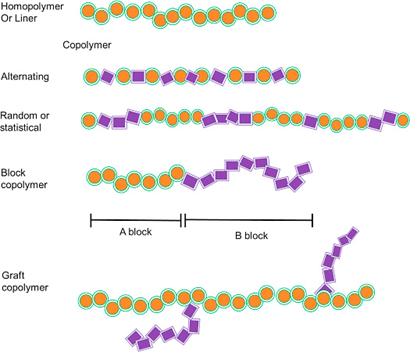
Copolymers are classified based on the arrangement of different types of monomers in the polymer chain. Copolymers are made up of two or more different monomers that are chemically linked together during the polymerization process. The way these monomers are arranged in the polymer chain determines the type of copolymer and affects its properties, behavior, and applications. Based on the arrangement of the monomers, there are four main categories of copolymers (Figure 1):
2.1. Random Co-polymers
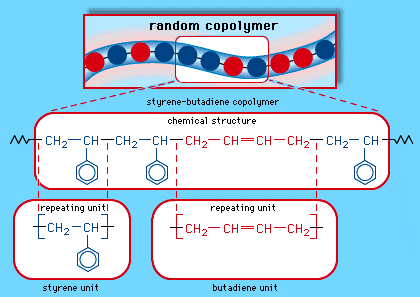
In random copolymers, the monomers are arranged randomly along the polymer chain, resulting in a non-uniform distribution of repeating units. This random arrangement results in a variety of chemical and physical properties throughout the polymer. The synthesis of random copolymers is relatively easy via free radical polymerization, in which different monomers are mixed together and their random incorporation occurs in the growing polymer chain. The properties of random copolymers lie between those of the constituent homopolymers, making them a versatile class of materials. Styrene-butadiene rubber (SBR) is a random copolymer widely used in the tire industry due to its excellent elasticity, abrasion resistance, and low-temperature performance (Figure 2).
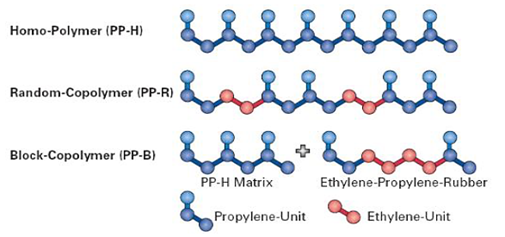
PP-R (Polypropylene Random Copolymer) is a thermoplastic polymer derived from the monomer propylene. The structure is classified as a random copolymer, meaning that it contains propylene monomer units as well as small amounts of a comonomer, typically ethylene. This random arrangement of comonomer units improves the properties and performance of the material (Figure 3).
The properties of PP-R are:
• High temperature resistance: PP-R can withstand relatively high temperatures and is suitable for hot and cold water applications. It can withstand up to 95°C (203°F) for long periods and up to 110°C (230°F) for shorter periods.
• Chemical resistance: This material is highly resistant to most acids, bases, and chemical agents commonly found in plumbing systems, ensuring its longevity and reliability.
• Low thermal conductivity: PP-R has low thermal conductivity, meaning it helps maintain fluid temperatures better than other materials such as metal pipes, reducing heat loss.
• Corrosion resistance: Unlike metal pipes, PP-R does not corrode, ensuring that water remains free of impurities and the pipes have a longer lifespan.
• Light weight: PP-R pipes are lightweight, which makes them easier to transport and install, reducing labor costs during construction.
• Noise reduction: PP-R pipes have sound-dampening properties and, as a result, exhibit quieter water flow than some other pipes.
2.2. Alternating Co-polymers
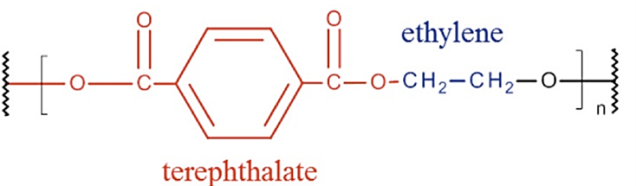
In alternating copolymers, the monomers are arranged in a regular and predictable pattern along the polymer chain. The resulting structure is a uniform repetition of two monomers that form a stable and well-defined arrangement. Intermittent copolymers are usually synthesized by step-growth polymerization, where two complementary monomers react with each other, removing small molecules in the process. Polyethylene terephthalate (PET) is an alternating copolymer composed of ethylene glycol and terephthalic acid units that is widely used in beverage bottles due to its strength, transparency, and high resistance to moisture (Figure 4).
2.3. Block Co-polymers
Block copolymers are made up of two or more separate blocks of monomers that are covalently linked together. Each block has a relatively long sequence of one type of monomer before transitioning to the next block.
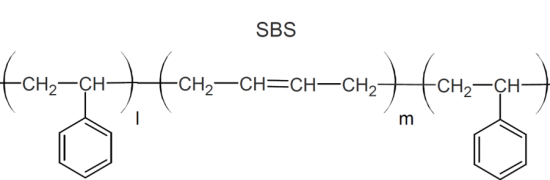
Block copolymers exhibit microphase separation, which results in the formation of distinct regions or domains with different properties. The arrangement of the blocks gives block copolymers unique properties, such as improved mechanical properties and improved phase stability. Polystyrene-polybutadiene (SBS) is a block copolymer used in adhesives and shoe soles. The polystyrene block contributes strength, while the polybutadiene block contributes elasticity and flexibility (Figure 5).
2.4. Graft Co-polymers
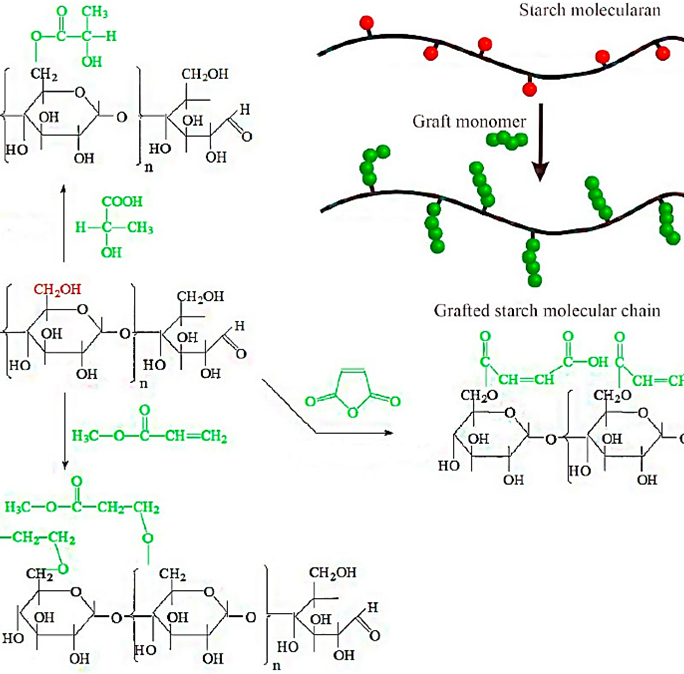
Graft copolymers have a main chain (backbone) consisting of one type of monomer to which side chains of a different monomer are attached. The side chains can be short or long and can be regularly spaced or randomly distributed along the main chain. Graft copolymers combine the properties of the main chain and the side chain, resulting in a unique combination of properties. Graft starch copolymers are used as soil conditioners. The main chain of the copolymer provides water solubility, while the side chains help improve soil structure and water retention (Figure 6).
Each class of copolymers has distinct advantages and applications that make them versatile and valuable materials in various industries and scientific fields. The choice of copolymer arrangement depends on the properties required for a given application and the synthesis method used in the polymerization process.
3. Synthesis of copolymers
Copolymer synthesis methods refer to various techniques used to produce copolymers through the polymerization of two or more different monomers. These methods allow for the controlled incorporation of different monomers, resulting in copolymers with specific compositions, structures, and properties. Some of the common copolymer synthesis methods will be discussed below.
3.1. Free Radical Polymerization
Free radical polymerization is one of the most widely used methods for producing copolymers. In this process, a radical initiator is used to generate free radicals, which initiate the polymerization reaction of monomers. The monomers react with these free radicals to form copolymer chains. Reaction conditions, such as temperature and concentration, can be adjusted to control the incorporation of monomers and the composition of the final copolymer.
3.2. Addition Polymerization
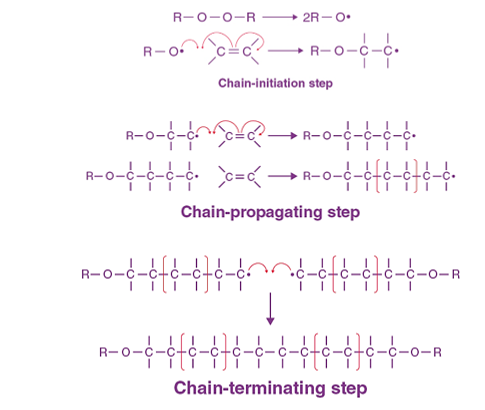
Addition polymerization is a type of polymerization in which monomers containing carbon-carbon double bonds (unsaturated monomers) undergo a series of addition reactions to form a copolymer. Common methods of addition polymerization include radical addition polymerization (Figure 7) and coordination polymerization. This method allows the synthesis of copolymers with different monomer ratios and sequences.
3.3. Condensation Polymerization
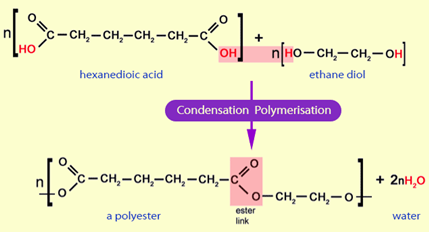
Condensation polymerization involves the reaction between monomers with functional groups such as hydroxyl and carboxyl groups. During the reaction, small molecules such as water or methanol are removed, resulting in the formation of a copolymer and other by-products. This method is commonly used to produce copolymers such as polyesters and polyamides (Figure 8).
3.4. Ring-opening Polymerization
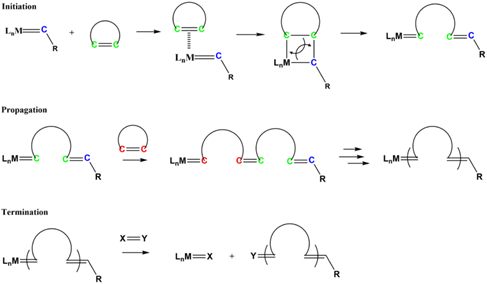
Ring-opening polymerization is used for cyclic monomers such as lactones and cyclic esters. This reaction opens the ring structure of the monomers, allowing them to polymerize and form copolymers. This method is used to produce copolymers such as polyethylene glycol-co-caprolactone (PEG-co-PCL) and polylactic acid-co-glycolic acid (PLGA) (Figure 9).
3.5. Living Polymerization
Living polymerization techniques, such as living radical polymerization, living anionic polymerization, and living cationic polymerization, allow for precise control of the polymerization process. These methods enable the synthesis of copolymers with well-defined chain lengths, low dispersion, and controlled monomer sequences.
3.6. Emulsion Polymerization
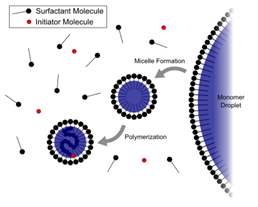
Emulsion polymerization is a process in which monomers are dispersed in an aqueous medium with the aid of surfactants. Polymerization occurs in monomer emulsion droplets and results in the formation of copolymer particles. Emulsion polymerization is commonly used to produce latex copolymers used in coatings and adhesives (Figure 10).
3.7. Suspension Polymerization
Suspension polymerization is similar to emulsion polymerization, but the monomers are dispersed in a non-aqueous medium with the help of stabilizers. The monomers polymerize in suspended droplets, forming copolymer particles. Suspension polymerization is used to produce copolymers such as polyvinyl chloride (PVC).
These synthetic methods allow researchers and engineers to tailor the composition, molecular weight, and structure of copolymers to meet specific application needs. By controlling the polymerization conditions, copolymers with desired properties can be created, transforming them into versatile materials used in a wide range of industries.
4. Applications of copolymers
The diverse properties of copolymers open up a wide range of applications in various industries.
4.1. Biomedical applications
Copolymers have revolutionized the fields of medicine and biotechnology, some of whose applications are listed below:
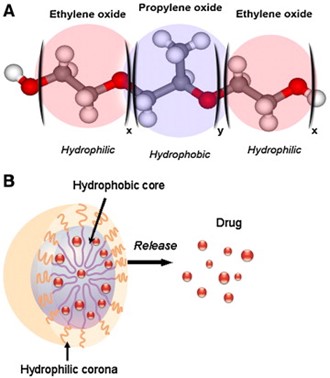
(a) Targeted drug delivery: Copolymers can provide controlled and sustained release of drugs, enhancing therapeutic efficacy while reducing side effects. For example, poly(lactic-co-glycolic acid) (PLGA) copolymers have been widely used in drug delivery systems for various therapeutic applications (Figure 11).
(b) Tissue engineering: Frameworks made of biocompatible copolymers can lead to tissue regeneration and organ transplantation. For example, poly(lactide-co-caprolactone) copolymers (PLCL) are used in tissue engineering frameworks for bone and cartilage regeneration.
c) Medical implants: Copolymers with suitable mechanical and biocompatible properties serve as implant materials for joint replacement and dental applications. Polyetheretherketone (PEEK) copolymers are used in orthopedic implants due to their biocompatibility and mechanical strength.
4.2. Packaging and Plastics
Copolymers have significantly contributed to the development of innovative packaging materials.
Protective properties: Copolymers improve the protective properties of packages against gas and moisture, extending the shelf life of perishable products. Ethylene vinyl alcohol (EVOH) copolymers are widely used in food packaging to prevent oxygen ingress and increase the freshness of the contents.
Biodegradable copolymers: Eco-friendly copolymers contribute to sustainable packaging solutions and reduce environmental impact. Polylactic acid (PLA), a copolymer derived from renewable resources, is increasingly used in biodegradable packaging materials.
4.3. Electronics and Optoelectronics: The unique electronic properties of certain copolymers make them valuable in electronic devices. For example:
Organic Light-Emitting Diodes (OLEDs): Copolymers with high electron and hole mobility act as efficient emissive layers in OLEDs, leading to increased display performance and energy efficiency.
Organic Photovoltaics (OPVs): Copolymers with tunable energy levels help improve photovoltaic performance in solar cells.
4.4. Energy storage and conversion
Copolymers are critical components in energy storage and conversion devices.
Lithium-ion batteries: Copolymers can enhance the performance and safety of lithium-ion batteries by providing stable electrolytes and preventing dendrite formation. For example, polyethylene oxide (PEO)-based copolymers are being investigated for their potential in solid-state lithium batteries.
Fuel cells: Proton-conducting copolymers are essential components in proton exchange membrane fuel cells (PEMFCs), which facilitate efficient energy conversion with lower greenhouse gas emissions (Figure 12).

Conclusion
As a result, copolymers have emerged as a versatile and essential class of materials with a wide range of applications and synthesis methods. Copolymers have been proven to have a high ability to combine distinct monomers in a controlled manner, and as a result, they can create a wide range of materials with different properties. By carefully selecting the monomers and adjusting their ratio, copolymers can be engineered to exhibit a set of desired properties, including increased mechanical strength, improved thermal stability, increased flexibility, and high chemical resistance. These properties enable copolymers to revolutionize industries such as packaging, automotive, healthcare, electronics, etc. Furthermore, the synthesis methods of copolymers have advanced significantly, allowing for precise control over molecular architectures and appropriate distribution patterns.
Techniques such as free radical polymerization, condensation polymerization, and living polymerization have played pivotal roles in designing copolymers with well-defined structures and narrow molecular weight distributions. Furthermore, advances in nanotechnology and polymerization techniques have opened up new opportunities for the production of copolymers with complex functionalities and nanostructured morphologies. In recent years, research efforts have focused on developing sustainable and environmentally friendly copolymer production methods using renewable raw materials and applying green chemistry principles. These environmentally conscious approaches will lead to a reduction in the environmental impact of copolymer production and help to build a more sustainable future.
In short, copolymers have emerged as a cornerstone of materials science and engineering, offering a vast scope for innovation and creativity. The future will see many advancements for copolymers, and their role in advancing technology and addressing global challenges cannot be overstated. By fostering interdisciplinary collaborations and embracing sustainable practices, we can fully expand the potential of copolymers and harness their transformative power for a better and more sustainable world.
Compiled by: Dr. Mehrnaz Bahadori
Scientific Editor: Zahra Davatgari
Resources
1. Singh, N., & Riaz, U. (2022). Recent trends on synthetic approaches and application studies of conducting polymers and copolymers: a review. Polymer Bulletin, 79, 10377-10408.
2. Policastro, G., Panico, A., & Fabbricino, M. (2021). Improving biological production of poly (3-hydroxybutyrate-co-3-hydroxyvalerate) (PHBV) co-polymer: a critical review. Reviews in Environmental Science and Bio/Technology, 20, 479-513.
3. Journal of Polymer Research. (2023). A peer-reviewed journal that covers all aspects of polymer science and engineering.
4. Raza, Z. A., Abid, M., Banat, F., & Shakeel, A. (2019). Polyhydroxyalkanoates: characteristics, production, recent developments and applications. International Journal of Biological Macromolecules, 133, 850-867.
5. Feng H, Lu X, Wang W, Kang NG, Mays JW. Block Copolymers: Synthesis, Self-Assembly, and Applications. Polymers (Basel). 2017 Oct 9;9(10):494.