
Abstract
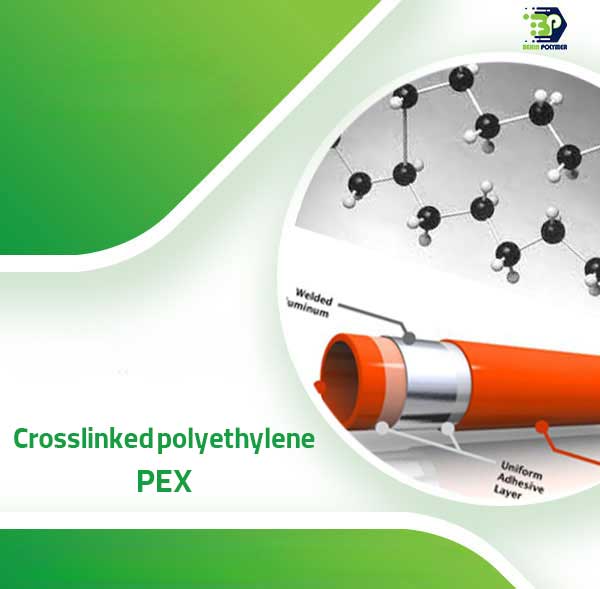
PEX (cross-linked polyethylene) has emerged as a versatile and highly efficient polymer in various industries, exhibiting exceptional properties that contribute to its popularity. In the construction industry, PEX pipes exhibit properties such as flexibility, durability, and resistance to cracking, along with ease of installation. This report provides an overview of the manufacturing process and characteristics of PEX.
Keywords: PEX, crosslinked polyethylene, piping, PEX benefits
Introduction
Polyethylene or polythene (IUPAC name polyethene or poly(methylene)) is the most commonly produced plastic. This polymer is primarily used for packaging (plastic bags, plastic films, geomembranes and containers including bottles, etc.). Polyethylene accounts for over 70% of the total plastics market, is readily available, relatively low cost and is easily processed at temperatures of 150–250°C.
This polymer is used in household items, packaging, insulation and medicine. Most polyethylene compounds contain large amounts of fillers. The polymer is thermoplastic and can therefore be processed many times. However, polyethylene becomes soft and fluid and loses its vital physical properties at high temperatures, thus limiting its applications. Crosslinking in polyethylene helps maintain its desirable properties at high temperatures, changing the nature of polyethylene from thermoplastic to thermoset, and thus creating a more stable polymer matrix.
Polyethylene types such as linear low-density polyethylene (LLDPE), low-density polyethylene (LDPE), high-density polyethylene (HDPE), and ethylene vinyl acetate copolymer (EVA) and polyolefin elastomer (POE) have the ability to be crosslinked. Among the various structures of polyethylene chains, branched structures are more suitable for crosslinking, so crosslinking in LLDPE and HDPE requires more attention.
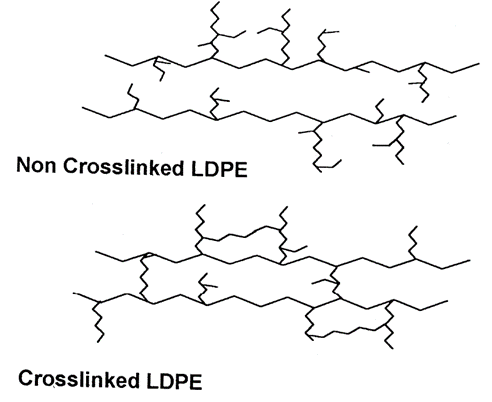
Crosslinking creates an insoluble, infusible polymer in which polymer chains are linked to form 3D structures. Crosslinking polyethylene also forms a dense, high molecular weight network that significantly improves impact strength, ESCR, and creep and abrasion resistance without affecting tensile strength or density, while reducing elongation at break and melt flow index. Figure 1 shows a picture of polyethylene chains before and after crosslinking.
PEX synthesis methods
The process of crosslinking polyethylene is carried out in two ways: physically and chemically.
1-Physical method: (PEX-c)
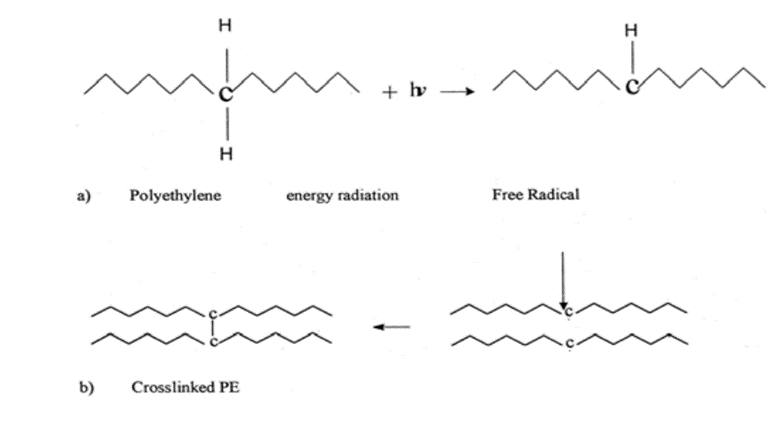
In this method, crosslinks are created with free radicals produced by high-energy radiation. This process is schematically shown in Figure 2:
Advantages of using the radiation method in creating crosslinks of polyethylene
1- The crosslinking reaction takes place at room temperature.
2- The reaction is completed quickly and has a high yield.
3- The reaction can be carried out without any additives.
4-Creating cross-connections is done in only one step.
Disadvantages of using the radiation method in creating crosslinks of polyethylene
1-High cost.
2- It is difficult to create cross-links in materials with irregular and complex shapes.
3. Safety measures are required to protect operators from radiation.
2-Chemical method:
Chemical crosslinking is a method in which chemicals or initiators are used to generate free radicals, which in turn lead to the formation of crosslinks in the polymer. In this method, crosslinking occurs either through direct carbon-carbon bonds or through chemical bridges that connect different polyethylene molecules together.
The two main methods of creating chemical crosslinks are:
1-Peroxide-based (PEX-a)
2-Silan-based (using moisture) (PEX-b)
The degree of crosslinking in thermoplastic resins varies depending on the crosslinking process. The peroxide crosslinking method produces the highest and most uniform degree of crosslinking compared to the physical method. The degree of crosslinking in the radiation method is 34-75%, while in the chemical method using peroxide this value reaches above 90% and in the chemical method using silane, the degree of crosslinking is 45-70%.
Peroxide-based chemical crosslinking: (PEX-a)
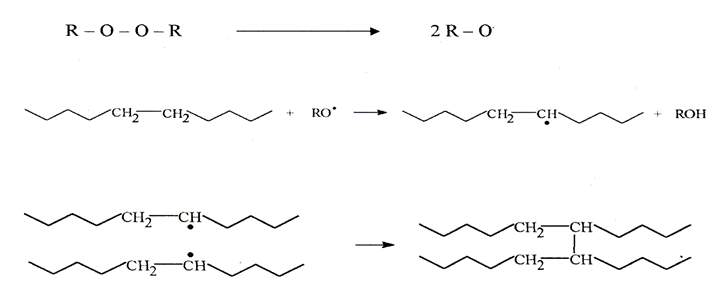
In this method, organic peroxide is used as the initiator. The combination of polyethylene and peroxide must be carried out at a temperature below the decomposition temperature of the peroxide. The crosslinking is carried out in downstream equipment at high temperature and pressure. Temperatures above the decomposition temperature of the peroxide decompose the initiator and cause the formation of a free radical, which removes a hydrogen atom from the polymer chain and becomes an active radical and forms a crosslink with another active radical from the same or different chain. This reaction occurs until all the peroxide is consumed or the temperature drops below the decomposition point. A schematic representation of this reaction is shown in Figure 3.
Advantages of the peroxide method
1- Excellent thermal stability
2- Ease of mixing
3-High durability
Disadvantages of the peroxide method
1-High cost
2- Surface adhesion in the presence of oxygen
Chemical crosslinking with silane: (PEX-b)
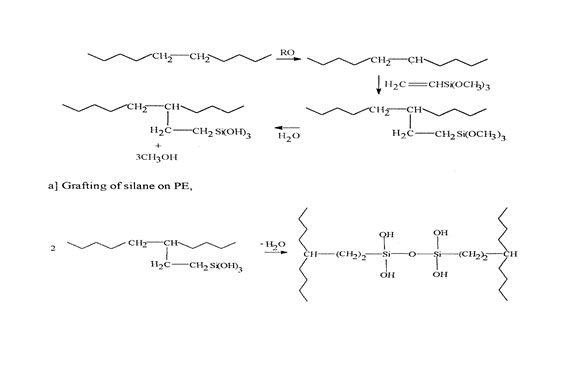
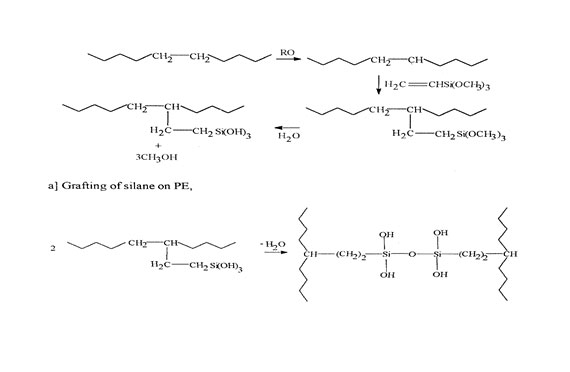
In this method, silane molecules are grafted onto the polyethylene chain. To graft these molecules, a small percentage of peroxides such as dicumyl peroxide are first mixed with polyethylene. The peroxide initially produces free radicals on the polyethylene chain, and the silane bonds with the polyethylene at the site of free radical production, and ultimately the extruded or injection molded products are crosslinked in the presence of water vapor. The silane crosslinking process is shown schematically in Figure 4:
Advantages of the method of creating silane cross-connections:
1- The cross-linking process is carried out at room temperature.
2- It has a relatively lower cost than the previous method.
3- Higher gel percentage than the physical method
Disadvantages of the method of creating cross-flow joints:
1- The curing time is longer compared to the peroxide method.
2- Additional downstream equipment is required.
3- The strength of crosslinked bonds is lower than that of the peroxide method.
The most common use of cross-linked polyethylene is in the electrical cable industry. Cross-linking, while not affecting the dielectric properties of polyethylene, creates resistance to flow and permanent deformation at temperatures above its softening point. Cross-linked polyethylene is also widely used in hot and cold water pipes. The use of cross-linked polyethylene (PEX) plastic water pipes, replacing copper pipes, is increasing widely in building construction. In addition, PEX pipes are widely used in underground water lines, domestic water supply lines and underfloor heating systems.
The advantages of using PEX in plumbing systems over copper pipes include:
1- Flexibility
2-Less pressure drop
3- Lower material costs
4- Easier installation
5- No fire risk during installation
6- Ability to integrate PEX with existing copper and PVC systems
7- Less likely to burst due to freezing
8- Possibility of pipe insulation
Problems with using PEX in plumbing systems:
1- Possibility of destruction by sunlight.
2- Possible health effects.
3- Possibility of perforation by insects.
Conclusion
In conclusion, PEX (Cross-linked Polyethylene) has revolutionized the plumbing and heating industry with its exceptional properties and wide range of applications. Its flexibility, durability, and resistance to cracking make it an ideal choice for installation in a variety of environments. PEX’s chemical resistance and thermal performance contribute to its reliability and efficiency in delivering clean water and maintaining optimal heating systems. PEX provides convenience and peace of mind with its ease of installation and compliance with standards.
As the industry continues to innovate, the future of PEX looks promising.
Continuous improvements in crosslinking methods and material formulations have been made with the aim of further enhancing its properties and performance. Innovations such as advanced pipe joining techniques and intelligent piping systems have the potential to simplify installations and improve system monitoring and maintenance.
Overall, PEX has proven to be a reliable and cost-effective solution for plumbing and heating needs. Its exceptional properties and future prospects make it the preferred choice in the industry, providing efficient and sustainable solutions for a wide range of applications.
Compiled by: Samin Saleki
Edited by: Dr. Mehrnaz Bahadori
Resources
1. Oral E, Muratoglu OK. Crosslinked polyethylene. Materials For Total Joint Arthroplasty: Biotribology Of Potential Bearings. 2015 Oct 14:133.
2. https://en.wikipedia.org/wiki/Main_Page.