
Abstract:
Ziegler-Natta and metallocene catalysts have revolutionized the field of polymerization, allowing the production of polymers with a wide variety of structures and controlled structures. Ziegler-Natta catalysts, which are combinations of transition metals and organometallic co-catalysts, are widely used in the polymerization of alpha-olefins such as ethylene and propylene, and facilitate the production of polymers with a variety of molecular structures. Despite the widespread use of these catalysts, the need for greater control over the properties of polymers has led to the development of metallocene catalysts, which provide precise control over the structure of polymers at the molecular level. Metallocene catalysts, which contain transition metals linked to symmetrical ligands, allow the production of polymers with narrow molecular weight distributions, selectable stereochemistry, and improved mechanical properties. This article discusses the definition, characteristics, and applications of Ziegler-Natta and metallocene catalysts, and compares the advantages and limitations of each.
1. Introduction
Catalysts play a fundamental role in many industries as chemical reaction facilitators. These materials lower the activation energy, allowing complex reactions to occur under optimal conditions (Figure 1).
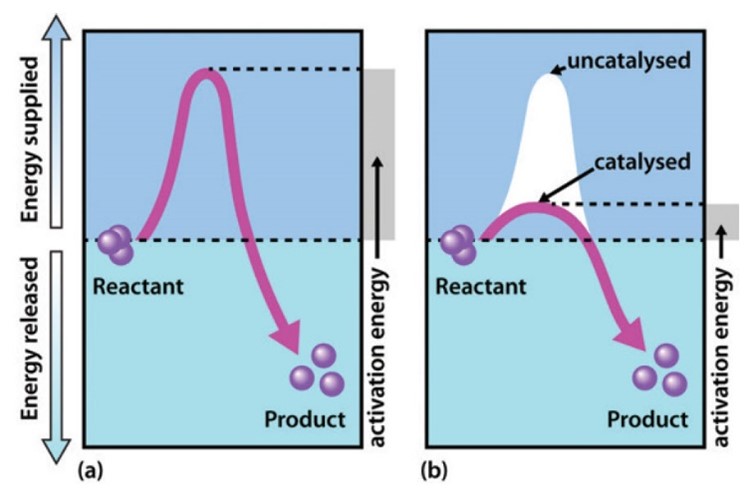 Figure 1: Comparison of the activation energy of reactants a) in the absence of catalyst and b) in the presence of catalyst
Catalysts increase the rate of chemical reactions without being consumed in the reaction themselves. These compounds are divided into two main categories: homogeneous and heterogeneous. Homogeneous catalysts are present in the same phase as the reactants (usually liquid or gas) and offer high efficiency and effectiveness due to their uniform interaction with the reactants; however, their separation from the final product can be challenging. In contrast, heterogeneous catalysts are in a different phase from the reactants (usually solid in a liquid or gas environment) and are easier to separate from the reaction product. Heterogeneous catalysts are also more suitable for many industrial processes in terms of stability and recyclability. The choice of the type of catalyst depends on factors such as reaction conditions, type of final product, need for catalyst reuse, etc. The use of catalysts is essential in a wide range of industries, including chemical production, oil refining, pharmaceutical synthesis, and biofuel production. Among the different types of catalysts, Ziegler-Natta catalysts and metallocenes are of particular importance in the polymer industry.
2. Ziegler-Natta catalysts:
Ziegler-Natta catalysts, named after Karl Ziegler and Giulio Natta, were discovered in the 1950s and are considered one of the most important tools in the petrochemical industry for the production of polymers. These catalysts are particularly useful for the production of high-density polyethylene and isotactic polypropylene. The discovery of these catalysts not only led to the two scientists receiving the Nobel Prize in Chemistry in 1963, but also revolutionized polymerization methods. Ziegler-Natta catalysts are usually composed of titanium complexes such as titanium tetrachloride and aluminum alkyl complexes and can produce polymers with specific structures and diverse physical properties (Figure 2).
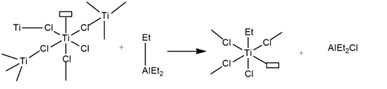 Figure 2: Formation of Ziegler-Natta catalyst from titanium and aluminum complexes
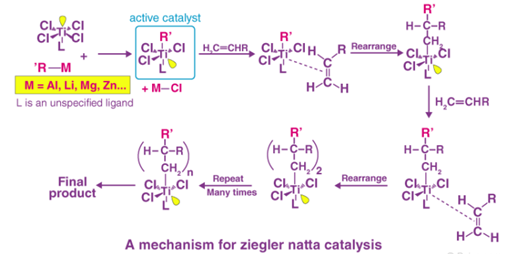
One of the most striking features of these catalysts is their ability to produce polymers with a specific spatial arrangement. Ziegler-Natta catalysts have the ability to produce high molecular weight polymers that were previously not possible to prepare by other methods. These catalysts can be homogeneous or heterogeneous, the homogeneous type of these catalysts is soluble in the reaction medium and is usually used for specific applications, while the heterogeneous type of these catalysts is more widely used in industrial processes and is placed on supports such as magnesium chloride or magnesium hydroxide, which leads to increased selectivity of the spatial arrangement of the polymer. The performance of these catalysts is affected by various parameters, including the molar ratio of the starting compounds and the type of catalyst support. Figure 3 shows the mechanism of action of these catalysts.
3. Metallocene catalysts:
Metallocenes are a newer generation of catalysts in the petrochemical industry that, with their more advanced molecular structure, allow the production of polymers with unique mechanical and thermal properties. Metallocene compounds are a class of organometallic compounds that are mainly used in the polymerization of olefins. These catalysts contain a transition metal (usually from groups 4 to 6 of the periodic table, such as titanium, zirconium, or hafnium) that is sandwiched between two cyclopentadienyl anions, creating a “sandwich”-like structure (Figure 4).
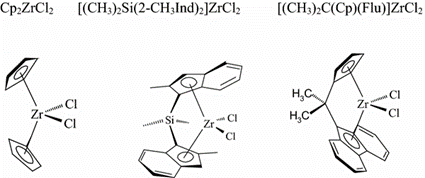 Figure 4: Some metallocene catalyst compounds
This arrangement gives metallocenes unique properties, particularly the ability to produce highly uniform polymers. The central metal atom is coordinated by additional ligands (which can be neutral or anionic), which affect the activity and selectivity of the catalyst. Metallocene catalysts are part of a broader class of single-site catalysts, meaning that they have active sites with well-defined and uniform structures that offer precise control over the microstructure of the polymers, including molecular weight, branching, and stereochemistry. Metallocene catalysts are widely used in the production of polyolefins such as polyethylene (PE) and polypropylene (PP). Their ability to produce specific polymers has made them valuable in the production of specialty materials. For example, metallocene catalysts are used to produce linear low-density polyethylene (LLDPE), which has superior mechanical properties, transparency, and processability compared to traditional Ziegler-Natta catalysts. They are also used to produce isotactic or syndiotactic polypropylene, which allows for better control over crystallinity, melting temperature, and impact strength. In addition, metallocene catalysts are used in the production of elastomers and specialty polymers that require precise control over the polymer chain structure. Structurally, the cyclopentadienyl rings can be modified with substituents to tune the electronic and steric environment around the metal center and optimize the catalyst performance for specific polymerization reactions. This customization capability allows metallocenes to produce block copolymers, random copolymers, or even polymers with narrow molecular weight distributions. Overall, metallocene catalysts represent a significant advance in catalyst technology and offer precise control over polymer design, which is essential for modern materials engineering.
4. Comparison of Ziegler-Natta and metallocene catalysts:
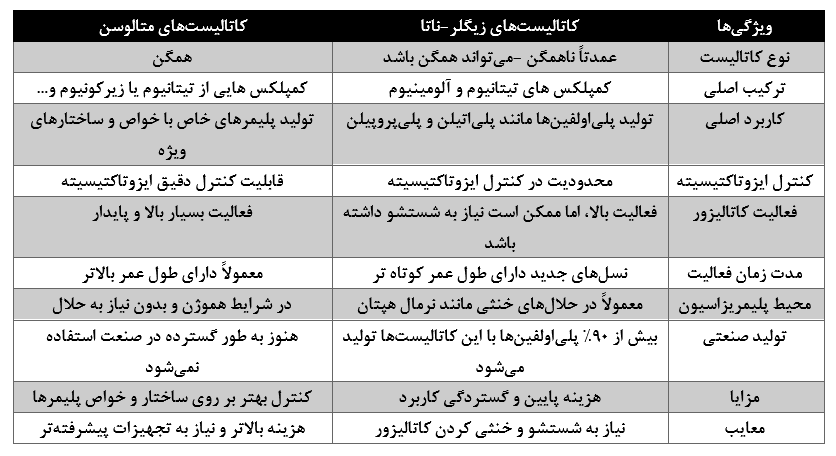
Both Ziegler-Natta and metallocene catalysts are used in the petrochemical industry, but each has specific properties that make them suitable for specific applications. Ziegler-Natta catalysts continue to dominate the industry due to their ability to produce high molecular weight polymers at low cost. In contrast, metallocene catalysts are emerging as a new option with the ability to provide more precise control over polymer structure and create specific properties. The following table outlines some of the differences between these two important catalysts:
5. Conclusion
Ziegler-Natta and metallocene catalysts play a vital role in the polymer and petrochemical industries and have revolutionized the production of polymeric materials. Ziegler-Natta catalysts are widely used in the polymerization of olefins due to their cost-effectiveness, high efficiency, and mass production capability. On the other hand, metallocene catalysts allow for the production of products with higher efficiency and strength by precisely controlling the molecular structure and properties of polymers. These two types of catalysts have contributed to the advancement of industrial processes, cost reduction, and development of innovative technologies, and play a key role in the design of advanced and more sustainable materials. The choice between them depends on the specific needs of the process and the final product.
Resources:
Kashiwa, N. (2004). The discovery and progress of catalyst systems for polyolefin production. Progress in Polymer Science, 29(1), 3-17. https://doi.org/10.1016/j.progpolymsci.2003.10.001
Kaminsky, W. (2013). Metallocene Catalysts: Synthesis, Characterization and Applications. Springer Berlin Heidelberg. https://doi.org/10.1007/978-3-642-40763-1
Malpass, D. B. (2010). Introduction to Industrial Polyethylene: Properties, Catalysts, and Processes. John Wiley & Sons. https://doi.org/10.1002/9780470900468
Zohuri, G. H., Damavandi, S., Ahmadjo, S., & Sandaroos, R. (2014). Recent advances in Ziegler-Natta catalysts for polyolefin production. Polyolefins Journal, 1(1), 25-32.
Resconi, L., Cavallo, L., Fait, A., & Piemontesi, F. (2000). Selectivity in Propene Polymerization with Metallocene Catalysts. Chemical Reviews, 100(4), 1253-1346. https://doi.org/10.1021/cr9804691
Content compiler: Zahra Davat-Gari
Scientific Editor: Dr. Mehrnaz Bahadori