

1. Introduction
Compound Annual Growth Rate (CAGR) is one of the most important indicators in economic, financial and industrial analysis that is used to examine the growth trend of a certain amount over a period of time. This indicator helps to assess market growth, forecast demand and strategic planning, especially in many manufacturing industries such as polymers and petrochemicals. Unlike simple growth rate, which only shows the change in the initial and final amount, CAGR presents the growth trend in an exponential and average form and is used to compare the performance of different companies, markets and investments. It is predicted that the global polymers market will reach about $1285.4 billion by 2033, which was $752.5 billion in 2023. It seems that the CAGR of this market will grow at an annual rate of 5.5% from 2023 to 2033.
In general, the polymers market refers to the global industry for the production, processing, and distribution of polymers. Polymers are large molecules composed of repeating structural units, usually linked by covalent chemical bonds. Polymers are widely used in various industries, including plastics, rubber, fibers, adhesives, and coatings, due to their diverse properties and applications. These materials are divided into the categories of natural polymers (such as proteins and cellulose), synthetic polymers (such as plastics and synthetic rubber), and biopolymers (polymers derived from renewable and biodegradable resources). The most common synthetic polymers include polyethylene, polypropylene, polyvinyl chloride (PVC), and polystyrene, which are mainly used in the production of consumer goods, packaging materials, construction materials, automotive parts, and other industrial products.
The polymers market is driven by various factors such as increasing demand for lightweight and durable materials in the automotive and aerospace industries, increasing use of biodegradable polymers (due to increasing environmental concerns), innovations in polymer chemistry leading to new product applications, etc. In addition, expanding economies, especially in Asia-Pacific countries such as China and India, have contributed to the significant growth of the polymers market. The region has emerged as a major hub for the production and export of polymer-based products due to the availability of lower-cost raw materials and labor, coupled with increasing domestic demand.
Challenges in the polymers market include regulatory pressures related to environmental impact, fluctuating raw material prices, and the need for recycling and sustainable practices due to the non-biodegradable nature of many synthetic polymers. However, advances in recycling technologies and the development of new and sustainable polymer materials continue to provide opportunities for market growth.
According to Fact.MR, a provider of market intelligence and competitive analysis, the global biomass-balanced polymers market value exceeded $4.2 billion in 2024 and is expected to grow at a CAGR of 10.5% during the forecast period 2024-2034. Biomass-balanced polymers represent a significant step in the development of sustainable materials. Traditional biopolymers often face performance and manufacturing process issues, but bio-balanced options strike a balance between traditional and fully sustainable materials. The growth of this market is in line with corporate sustainability goals and regulatory requirements, without compromising product performance. In this area, increasing environmental awareness and policy revisions to reduce carbon emissions have contributed to the growth of this market. These polymers are produced from renewable raw materials but have similar quality and performance to conventional polymers. According to a newly released report by Fact.MR, these products have high growth potential in the packaging, automotive and consumer products sectors. The report also points to positive consumer attitudes and shows that the European market is leading the way due to high sustainability standards and increasing consumer demand for eco-friendly products. In the Asia-Pacific region, these materials are rapidly gaining acceptance, especially in China and Japan, driven by environmental concerns and government initiatives.
2. Definition and calculation of compound annual growth rate (CAGR)
CAGR shows the average annual growth rate of a value over a period of time, assuming that the value in question grows at a constant rate each year. To calculate it, the following formula is used:
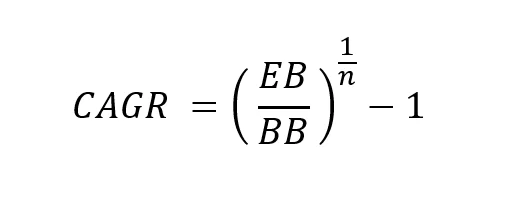
Where:
• EB Final value (e.g., the value of investment, production, or consumption at the end of the period)
• BB Initial value (value at the beginning of the period)
• n is the number of years in the period under consideration
To understand better, suppose that the polypropylene production capacity in a country increases from 500,000 tons in 2020 to 800,000 tons in 2025. The compound annual growth rate of this production will be calculated as 9.9% according to the above formula. This result shows that the production of this polymer material has grown by an average of 9.9% annually.
3. Importance of CAGR in Polymers Market Analysis
The polymer industry is one of the most important global industries, used in various sectors including packaging, automotive, medical, and electronics. CAGR analysis helps manufacturers and investors understand the growth rate of global demand for various polymers and make better decisions based on it. Here are some examples of CAGR data for various polymers:
Biodegradable Polymers Market: The global biodegradable polymers market is estimated to be worth $7.9 billion in 2023 and is projected to reach $55.2 billion by 2033, growing at a compound annual growth rate (CAGR) of 21.5% from 2024 to 2033.
Polypropylene Market: The global polypropylene market size is estimated to be around $123.46 billion in 2022 and is projected to expand at a compound annual growth rate (CAGR) of 4.7% from 2023 to 2030.
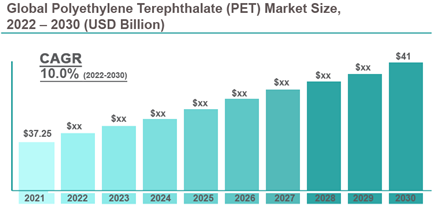
Polyethylene Terephthalate Market: The global polyethylene terephthalate (PET) market size was valued at $48.43 billion in 2023 and is projected to grow from $52.94 billion in 2024 to $109.63 billion by 2032, registering a CAGR of 9.5% during the forecast period. This growth is due to the increasing use of PET in beverage bottles, food packaging, and textile applications.
Engineering polymers such as polycarbonate (PC) and polyamides (PA) etc.: These materials are replacing metals in many industries due to their unique properties. The US engineering plastics market is expected to grow at a CAGR of 6.5% from 2024 to 2030.
4. Summary and Conclusion
Compound Annual Growth Rate (CAGR) is a key tool for analyzing the growth of markets, industrial production, and long-term investments. In the polymer industry, this indicator helps us examine global demand trends, production growth, technological changes, and investment opportunities.
CAGR analysis in the polymer industry shows that some segments, such as biodegradable polymers, are growing faster than others. This information can help petrochemical companies, polymer material manufacturers, and investors choose better strategies.
Resources:
https://www.wallstreetprep.com
https://www.fortunebusinessinsights.com
https://www.transparencymarketresearch.com/
https://www.precedenceresearch.com/polymers-marke
https://www.globenewswire.com/
https://market.us/
Content compiler: Zahra Davat-Gari
Scientific Editor: Dr. Mehrnaz Bahadori