
Abstract
Flame retardants play an important role in enhancing the safety of polymers by reducing their flammability. These additives are designed to slow or prevent the ignition and spread of fire in polymer-based materials, making them essential for a wide range of applications, from electronics to construction materials. This article provides an overview of flame retardants, their definition, types, mechanisms of action, and key applications, focusing on polymers used in industrial sectors. The article also explores the future outlook for flame retardants.
1. Introduction
Flame retardants play an important role in enhancing the safety of polymers by reducing their flammability. These additives are designed to slow or prevent the ignition and spread of fire in polymer-based materials, making them essential for a wide range of applications, from electronics to construction materials. This article provides an overview of flame retardants, their definition, types, mechanisms of action, and key applications, focusing on polymers used in industrial sectors. The article also explores the future outlook for flame retardants.
2. Definition of flame retardant
Flame retardants are chemical compounds added to materials to inhibit, delay, or suppress the combustion process. When flame retardants are incorporated into polymers, they reduce the likelihood of ignition and the spread of fire. Depending on the type of flame retardant and the polymer system used, they can act at different stages of combustion, including heating, ignition, flame propagation, and fire growth.
3. Types of flame retardants
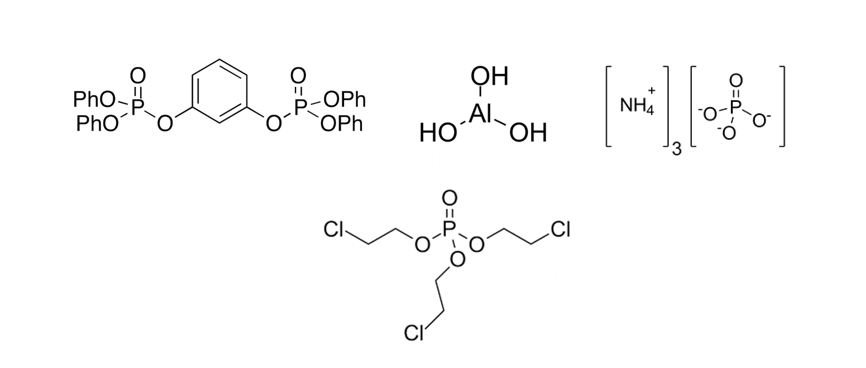
There are different types of flame retardants, which are generally classified based on their chemical composition and mechanism of action (Figure 1 shows the chemical structure of some of them):
1.3. Halogenated flame retardants:
These compounds, which are the most commonly used flame retardants, work by releasing halogen radicals that disrupt the combustion process. Common examples of these materials are brominated and chlorinated flame retardants. However, the use of these compounds is associated with environmental and health concerns due to the release of toxic gases during combustion.
2.3. Phosphorus-based flame retardants:
Phosphorus compounds can act in both the gas and solid phases. These materials reduce the emission of flammable gases by forming a carbon layer on the surface of the material. Examples include red phosphorus, ammonium polyphosphate, and organic phosphate-containing compounds.
3.3. Inorganic flame retardants:
These materials include compounds such as aluminum hydroxide (ATH) and magnesium hydroxide (MDH), which release water vapor when heated, cooling the material and diluting flammable gases. They are non-toxic and environmentally friendly, but often require higher loadings in the polymers.
4.3. Nitrogen-based flame retardants:
These compounds decompose during the combustion process and produce nitrogen gas, which helps dilute flammable gases and reduce the oxygen concentration around the flame. Examples of this category include melamine and its derivatives.
5.3. Expansive flame retardants:
Expansive flame retardants expand when exposed to heat and form a protective char layer on the polymer surface. This layer insulates the material from heat and reduces the availability of flammable gases. Intensifier formulations often include a combination of materials containing phosphorus, nitrogen, and carbon-based compounds.
4. Mechanism of action of fire retardants
Flame retardants work through different mechanisms depending on their chemical nature, which are briefly mentioned below.
1.4. Endothermic decomposition
Some flame retardants absorb heat during decomposition, lowering the temperature of the polymer and slowing down the combustion process. For example, aluminum hydroxide and magnesium hydroxide release water vapor and cool the polymer.
2.4. Gas phase inhibition
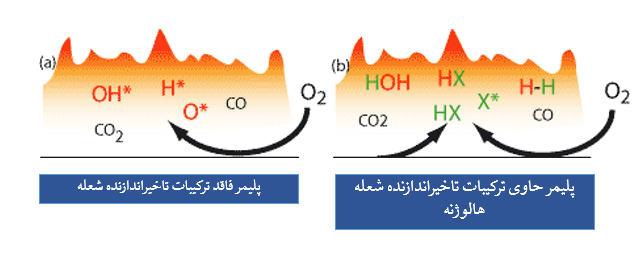
Halogenated flame retardants release halogen radicals (Cl• or Br•) that scavenge the high-energy hydrogen and hydroxyl radicals (H• and OH•) in the flame, reducing the fire energy and preventing further combustion. Figure 2 shows how these retardants work compared to polymers without flame retardants:
3.4. Formation of carbon layer
Phosphorus-based and expansive flame retardants cause the formation of a char layer on the polymer surface, which acts as a barrier to heat and oxygen and prevents the release of flammable gases.
4.4. Dilution of combustible gases
Nitrogen-based flame retardants release inert gases, such as nitrogen, which dilute flammable gases in the polymer matrix and reduce the oxygen available in the combustion zone.
5. Applications
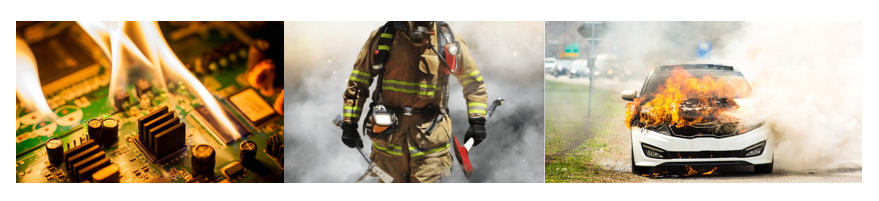
Flame retardants are used in a wide range of industries and applications (Figure 3):
1.5. Electricity and electronics
Flame retardants are essential for protecting electronic components from fire hazards, especially in products such as circuit boards, cables, and connectors.
2.5. Building and construction
Materials such as insulation, roofing, and pipes often contain flame retardants to increase fire resistance, especially in residential and commercial buildings.
3.5. Automotive industry
Flame-retardant polymers are used in various automotive components, including dashboards, seat covers, and electrical systems.
4.5. Textiles
Flame retardants are applied to fabrics used in clothing, upholstery, and curtains to prevent the spread of fire.
5.5. Aerospace and transportation
Aircraft interiors and public transportation systems require flame-resistant materials for safety in the event of a fire.
6. Most used
The most widespread use of flame retardants is in the electrical and electronics industries, where stringent fire safety standards necessitate the use of flame-retardant polymers. Brominated flame retardants (BFRs), phosphorus-based compounds, and antimony trioxide are commonly used in this sector due to their effectiveness in reducing fire hazards in advanced equipment.
7. Perspective
The most widespread use of flame retardants is in the electrical and electronics industries, where stringent fire safety standards necessitate the use of flame-retardant polymers. Brominated flame retardants (BFRs), phosphorus-based compounds, and antimony trioxide are commonly used in this sector due to their effectiveness in reducing fire hazards in advanced equipment.
8. Conclusion
Flame retardants are vital to ensure fire safety in polymer-based materials, especially in industries where fire hazards are significant, such as electronics, construction, and transportation, etc. While traditional flame retardants such as halogenated compounds are effective, their environmental and health impacts have led to a shift towards more sustainable, halogen-free alternatives.
references:
[1] https://www.mdpi.com/2073-4360/14/1/82
[2] https://www.frontiersin.org/journals/materials/articles/10.3389/fmats.2021.703123/full
[3] https://www.mdpi.com/journal/polymers/special_issues/8K2NC5IB05
[4] https://www.sciencedirect.com/science/article/pii/S0927796X20300620
[5] https://www.sciencedirect.com/science/article/abs/pii/S0141391023001660
[6] https://www.ncbi.nlm.nih.gov/pmc/articles/PMC8541075/
[7] https://pubs.rsc.org/en/content/articlelanding/2007/jm/b702511d
[8] https://chekad.com/fire-resistant-polymers/?lang=en
Compiled by: Zahra Davat-Gari
Edited by: Dr. Mehrnaz Bahadori